Tag: book recommendations

  • My personal favorite works of fantasy and science fiction

    My personal favorite works of fantasy and science fiction

    I’ve often written about foundational works of epic fantasy, high fantasy, and other speculative subgenres. But I haven’t talked much about my own favorite works—despite several of them slipping into the mix of content here on the blog.

    While I can think of plenty of obvious reasons each book appears on my list, there are likewise plenty of reasons for readers not to love the same books as me. This list probably won’t match anyone else’s breakdown of favorite SFF novels. It’s personal.

    I will of course describe some reasons I think other readers will likewise care about the books I’m mentioning. But at the end of the day, I’m listing them chiefly because of my own experiences with each novel listed.

    In reverse ranking order, here goes.

    10. Harpist in the Wind by Patricia McKillip

    Covert art for high fantasy novel Harpist in the Wind by Patricia McKillip

    My loose summary: Magical bards chase each other because they like knowing stuff and out-harping one another. And to save the world from shape shifting monsters.

    No surprise that Patricia McKillip would make the list. Harpist in the Wind is the climactic finish to the Riddle Master Trilogy, and as such, it’s one of the books that really answers riddles that have been posed across the previous two volumes. This, in particular, makes for a riveting conclusion to the trilogy.

    Since I’ve talked about the Riddle Master Trilogy in some detail before, let me say simply that every time I read this series (and Harpist in the Wind in particular), I’m astonished at something. It might be the subtle structuring of Morgon’s journey. It might be the evocative beauty and sense of sorrow present in the world McKillip has created. It might just be that I forgot all the answers to the riddles and I love to find them anew.

    There’s also the whole matter of mages dueling each other with mystical geolocational powers, shape changers chasing the main characters, Earth Masters showing up with magical demands, and so on. Little wonder that I love a novel so packed with musicians, mysteries, and wizards.

    In any case, Harpist in the Wind is one of the strongest conclusions I know to any fantasy trilogy and sits firmly on my list of all-time favorite SFF novels.

    9. The Sword of Kaigen by M. L. Wang

    Book cover for M. L. Wang's fantasy novel The Sword of Kaigen.

    My loose summary: A mom and her teenage son deal with parallel disillusionment while also being martial arts masters and having to prove it to some aggressive people.

    The only indie work on this list, The Sword of Kaigen is also the most recent addition to my stack of favorite SFF novels. (And yes, I’ve talked about this one elsewhere on the blog as well).

    The Sword of Kaigen follows two main characters. One is the 14-year old Mamoru,  who experiences a fresh but powerfully relatable coming of age journey as he grapples with governmental failures and a staggering amount of new responsibility protecting his home. The other chief protagonist is Mamoru’s mother, Misaki.

    The novel is incredibly unique in how it follows these two very different characters (a teenage boy and an emotionally exhausted mother). Furthermore, it takes a decidedly unusual approach to form and story shape, building up to climactic moments much earlier in the story than is normal and dwelling longer on the resolution needed afterward. It feels like a near perfect balance between slice-of-life fantasy and martial arts epic, rolling the elements together in a way I find seamless.

    This novel makes my list of favorites not just because it’s so different and refreshing. It also packs a profound emotional punch (due to its difference, in my opinion), making it unforgettable in nearly every aspect.

    8. Harry Potter and the Goblet of Fire by J. K. Rowling

    Cover art for fantasy novel Harry Potter and the Goblet of Fire by J. K. Rowling.

    My loose summary: Harry Potter competes in games that might kill him but cares more about social footing and friends because that’s real life for you.

    I love all seven Harry Potter novels, but Goblet of Fire very quickly became my favorite of the series. It’s not just that this is the only volume to win a Hugo or that Harry finally showed that he could be more uniformly competent. Those things help, but there’s so much more going well for this book.

    On one hand, Goblet of Fire has an amazing cast of side characters, including Ludo Bagman, Barty Crouch Sr., Barty Crouch Jr., and Rita Skeeter. Every Harry Potter novel has a similarly wondrous cast of characters that are neither chief villain nor principal friend to Harry, but I think the ensemble shines brighter in this volume than in any of the previous books, paving the way for some serious expansion in the next two volumes.

    Likewise, Goblet of Fire really set the tone for how the series could continue to be deadly serious while also zooming in on the everyday struggles of homework and having to go to a school dance. I think it’s fair to say that the plot is less fully baked in this book than in a few others in the series, but the constant tension between big stakes and small ones that really matter to the characters makes for a book that is constantly engaging, funny, warm, and heart-wrenching.

    7. Eldest by Christopher Paolini

    Cover art for epic fantasy novel Eldest by Christopher Paolini.

    My loose summary: All the main characters realize they’re making serious mistakes and have to learn or do some big stuff or else get eaten by the Raz’zac.

    Unusual though this may be, I often like book two in a series best of all (you’ll find three instances of book number two in a series on this list, actually). In most cases, the story doesn’t stand alone. The ending might not even be an end. But these still so often wind up as my favorites, as Eldest is among Christopher Paolini’s Inheritance Cycle.

    Paolini (and everyone on this list) has plenty of critics, but one of his great strengths as a writer is his ability to create a story spanning a wide spectrum of emotions. Some writers try, rather, to get one consistent tone or feeling throughout the full novel. This might seem cohesive, on the surface level, but it’s actually draining to read (no matter what the emotion is) and unrealistic.

    Eldest, in particular among Paolini’s books, weaves together smaller storylines about fear and suspicion, new friends found, pain, growth, unrequited love, unflinching love, new wounds forming, older wounds healing, and so many other parallel lines of feeling. There are within the manuscript great moments of failure, just as there are moments of immense hope.

    Every volume on this list (not an exaggeration; every volume) stitches together a similarly wide band of emotions, but Eldest is one of the books that first made me conscious of this dynamic.

    I think it could remain on my list of favorite books for that alone. After all, reading it has subsequently enriched my reading experience of all other stories.

    6. The Dark Forest by Cixin Liu

    Covert art for science fiction novel The Dark Forest by Cixin Liu.

    My loose summary: Four wildly smart people hatch secret plots to save the world while under constant up-close surveillance. Most of them end up getting tried for crimes against humanity.

    The second second book on the list, The Dark Forest is the lesser known volume following Cixin Liu’s highly regarded The Three-Body Problem. It is, however, not only an exceptional sequel but an incredible novel in its own regard.

    Part thriller, part mystery, part hard science fiction philosophical inquiry, The Dark Forest follows Luo Ji, a somewhat indifferent sociologist who gets thrown into an elite international circle and tasked with saving humanity from invading aliens. Various parties try to cripple or remove Luo Ji and his colleagues, so there’s no shortage of close calls, escapes, and intrigue.

    The real heart of the novel, however, comes from the link between Luo Ji’s task and his motivation for actually trying to complete it. To keep this fairly spoiler free, I’ll simply say that Cixin Liu really brings together the best of character-led storytelling and compelling hard science fiction concepts. Your reading might be enriched if you’re familiar with the first law of thermodynamics or the Fermi Paradox, but the story itself is powerful even without its ties to physics and cosmic sociology.

    5. Speaker for the Dead by Orson Scott Card

    Covert art for science fiction novel Speaker for the Dead by Orson Scott Card.

    My loose summary: Scientists and aliens try to understand each other and keep messing up, which risks their planet getting obliterated.

    Another second book in a series, Speaker for the Dead often falls under the reputational shadow (this is a pun) of other Enderverse novels. But there’s a stellar story here about the cultural power of words and the pain and solace that accompany them.

    Where Ender’s Game, mentioned later on this list, focuses on a much smaller cast of five or six key characters, Speaker for the Dead follows a large community of scientists, sentient aliens, families, and community leaders entangled in a search for knowledge.

    It’s a fairly standard sequel in the sense that it directly follows the events of Ender’s Game. It’s a wonderfully different sequel in how it stands on its own, thematically, and tells several whole stories even without finishing the series. This is not the only book on this list that ends with many threads left untied, but it might leave the biggest ones handy of any books I’m mentioning here. That said, Speaker for the Dead also has one of the most vivid endings of any novel I’ve read—hitting with greater force than nearly any other.

    Since I can remember the endings of eight books on this list well enough to quote them directly, I take Speaker for the Dead’s ending, almost alone, as evidence of its lasting impression on me.

    4. The Way of Kings by Brandon Sanderson

    Cover art for epic fantasy novel The Way of Kings by Brandon Sanderson.

    My loose summary: A slave becomes a boss.

    I was an early Brandon Sanderson reader. I got my hands on Elantris and later Mistborn shortly after they were released, with high hopes for both. It wasn’t until The Way of Kings came out and my brother gifted it to me that I became a Sanderson fan, however.

    The Way of Kings isn’t just next level for Sanderson. It’s next level epic fantasy in many genre-reaching ways. The scope and breadth of the story are, of course big (for lack of a more appropriate word that hasn’t been bandied plenty often already). But The Way of Kings still manages to thrive in smaller, more personal moments about perseverance, purpose, curiosity, belief, and fellowship. Long story short, the epic moments are about as epic as epic fantasy goes. And the personal moments are poignant in ways that bely the book’s massive wordcount.

    The worldbuilding is incredibly refreshing, the action is gripping, but what I love most about The Way of Kings is how hopeful it feels. Even as it tells a story about cycles of cataclysmic collapse, it presents a stalwart optimism that there’s a way forward. For all the instances of brutal mistreatment of underlings—some who are soldiers and some who are slaves—it’s a story about people rising above circumstances they shouldn’t be able to control by themselves.

    In most instances, The Way of Kings is about how people nurture each other’s hope and buoy one another only by banding together. Interestingly, nearly half the books on this list are about serious loners. Whether because of that trend in my tastes or in spite of it, The Way of Kings puts its stake in a wonderfully different spot of ground.

    3. The Farthest Shore by Ursula K. Le Guin

    Cover art for high fantasy novel The Farthest Shore by Ursula K. Le Guin.

    My loose summary: The world’s coolest wizard goes on an epic sea quest to stop everyone in Earthsea from getting seriously depressed.

    My loose summaries are obviously a little silly, but this one actually speaks to one of my favorite parts of this novel. The Farthest Shore isn’t a story about how horrible it would be if Thanos snapped his fingers and half of everyone died, or if Sephiroth called a meteor and it blasted the planet to bits. The stakes are much lower on the cosmic scale and much more real on the personal one.

    Where countless other fantasy novels are about the danger of everyone dying, The Farthest Shore is about the danger of everyone in the world losing their love of life.

    Magic, music, artistry, poetry, all these crafts are vanishing from the world, leaving people discouraged, listless, and hopeless. In a very Le Guin way, the novel’s events demand a solution that fits the issue, so instead of seeing a heroic character like the wizard Sparrowhawk get killed to save the world, we see many characters give up something beautiful and go on living anyway, not really knowing how they’ll proceed.

    It’s tragic, heroic, epic, poetic, and I never get tired of revisiting it.

    Oh, and there’s plenty of cool wizardry along the way.

    2. Ender’s Game by Orson Scott Card

    Cover art for science fiction novel Ender's Game by Orson Scott Card.

    My loose summary: A lonely kid has to save the human race from aliens because the grown-ups won’t let him have friends until he does.

    Another hard science fiction novel, another novel about finding a way for humanity to survive the threat of alien invasion, and the first author repeat on this list, I’ll leave most of Ender’s Game unsummarized. Since this is the second most well-known book on the list, you’ll probably be familiar with the concept, at least: After narrowly surviving one alien invasion, humanity has turned for help to a small coterie of highly intelligent children in anticipation of another.

    Ender’s Game is in many ways about how children and adults are so very alike. It’s also concerned with the ones we call our heroes are very much like the ones we call our enemies. At any rate, what I love most is how packed this short novel is with keen insights into why we do the things we do. It’s a masterwork in terms of worldbuilding, pacing, and point of view, but for me the wisdom and paradox of the narrative outweigh even the expert assembly that make a story of them.

    1. A Wizard of Earthsea by Ursula K. Le Guin

    Cover art for high fantasy novel A Wizard of Earthsea by Ursula K. Le Guin.

    My loose summary: The world’s coolest wizard goes on an epic sea quest to confront his childhood trauma and personal mistakes.

    This is the novel I’ve read the most times of any on this list (by far). Like Le Guin’s The Farthest Shore, A Wizard of Earthsea has presented me with new gems to treasure each time I return to its pages.

    On the surface, this looks like a simple coming of age redemption story. A reckless young wizard looses a monster on the world and has to stop it before it ruins everything. In standard Le Guin fashion, however, the stakes are actually personal rather than explosive. Yes, there’s a risk of trouble and even destruction if Sparrowhawk fails in his quest, but the real prices are for friendships that fail, boats that get broken, pets that get left behind in the snow, and the loss of selfhood threatening Sparrohwawk at every turn.

    I’ve written more about this book on the occasion of A Wizard of Earthsea’s golden anniversary in 2018, but for the sake of this already lengthy post I’ll just leave it at this: I waffled for years between reading and not reading, having a legitimately hard time believing I’d find a book worth my time. But after reading A Wizard of Earthsea, I’ve never stopped reading new ones.

    Since this book made a hungry reader of me, I can’t praise it enough.


    For more nerdy content like this, sign up for the monthly newsletter. It’s free to sign up, and you can unsubscribe any time.

    Sign me up

    * indicates required

    Intuit Mailchimp


    Headshot of epic fantasy author Stephen Taylor.

    About the Author

    Stephen Taylor is the author of The Witherclaw Trilogy as well as short fiction appearing in The Future Fire, MYTHIC Magazine, The Centropic Oracle, and other publications. His short story “Only an Ocean” won a Silver Honorable Mention in the L. Ron Hubbard Writers of the Future Contest. When he’s not writing, he’s often playing his violin or wandering in the woods.

  • Top-tier epic fantasy written by women

    Top-tier epic fantasy written by women

    I’ve many times seen strange comments on Twitter or Reddit about a lack of good epic fantasy written by women. Maybe the people making these comments just haven’t gone looking—because there’s plenty out there to find.

    Not all readers will agree on what I’m qualifying as epic fantasy today. But the works I’ll mention below all fit a few main criteria. They feature large storylines and casts of characters, secondary fantasy settings (even when they feel more like historical locales and cultures), the involvement of godlike magical beings, or just magical occurrences on an epic scale.

    With these criteria in mind, here’s a modest handful of outstanding epic fantasy written by women, including:

    The Farseer Trilogy by Robin Hobb: Epic, coming of age fantasy written for adults

    Cover art for Robin Hobb's book, Assassin's Apprentice, showing a tangled set of antlers.

    Robin Hobb, also known as Megan Lindholm, has a huge library of hard-hitting fantasy to her name(s). Her Realm of the Elderlings series spans 16 books. The Farseer trilogy is where most readers discover the series and remains Hobb’s most popular work to date.

    Farseer has plenty in common with other epic fantasy. There’s a medieval setting, magical training, and quests for the main character. The story also features mysterious enemy entities threatening the protagonist’s home, complex internal politicking, etc. Most epic fantasy readers will have read something with a similar macro plotline. What really makes Farseer stand out is Hobb’s unique delivery.

    On one hand, Hobb is refreshing in her choice to tell an epic story—which features a big cast of involved characters—all through the first-person point of view of a single character. Hobb’s approach to the coming of age journey in Farseer is unique as well. It follows FitzChivalry Farseer from his childhood into maturity in a way that’s clearly written for adults in the first place.

    I can’t say enough about Hobb’s ability to put distinctive characters and settings on the page. Skill for skill, I consider her at the top among epic fantasy writers. She’s an obvious choice when looking for epic fantasy written by women.

    Sign up for the newsletter

    Get the latest articles and updates on The Witherclaw Trilogy with Stephen’s monthly newsletter. Subscribing is free and you can opt out whenever you want.

    The Lotus Kingdoms Trilogy by Elizabeth Bear: Deep works without the monstrous wordcount

    Cover art for Elizabeth Bear's book, The Stone in the Skull, showing a dragon facing off with a swordsman.

    Like Hobb, Elizabeth Bear is a veteran author with a large library of works to show for herself. Bear has published over 65 short stories and 30 completed novels (all within just 20 years or so). She has shown her skill across epic fantasy, science fiction, and alternate history, among other speculative subgenres.

    Perhaps thanks to her serious work writing short stories, one of Bear’s notable powers is telling a story quickly. This skill is especially rare among epic fantasy writers. Yet Bear demonstrates it across multiple epic series, such as her Eternal Sky Trilogy and The Lotus Kingdoms.

    Bear’s books feel as if they were written with a clear sense of what the author wanted to say. So rather than being just another series about a band of misfits running interference in an inter-kingdom war, The Lotus Kingdoms brings its own refreshing sense of perspective to the type of story many epic fantasy readers expect. The story stands apart as a result. And it’s worth repeating how consistently Bear tells expansive stories in fleshed out settings without resorting to immense page counts.

    The Inheritance Trilogy by N. K. Jemisin: Smart books that honor their readers

    Cover art for N. K. Jemisin's epic fantasy book, The Hundred Thousand Kingdoms, showing an ornate stained-glass ceiling.

    I could just comment on how N. K. Jemisin is a MacArthur genius or the only author to win the Hugo award for all three books in one trilogy. But let’s talk writing quality as well.

    I recall feeling a little underwhelmed when I first began The Inheritance Trilogy. I soon realized it was because I had just read several books that insisted on explaining everything. Unlike many of her peer authors, Jemisin rarely dumbs things down for her readers. She writes with a great level of respect for the people picking up her books. The narrative skims over parts readers can figure out for themselves, leaving things understated rather than making them too obvious.

    That’s not to say that she refuses to offer any exposition or that her books are impossible to follow. But it is to say that Jemisin (a lot like Bear) packs more inside by using fewer words. Her books also offer higher reader rewards as you figure things out, follow characters’ logic, make sense of the setting on your own terms, and so on.

    Outside onlookers often comment first on Jemisin’s literary qualities—such as her audacity to write epic fantasy in second person. While, yes, this is an interesting thing about works like Jemisin’s Broken Earth trilogy use second person, I think there’s a lot more smarts and heart at work than just what this kind of surface level analysis will reveal. Given Jemisin’s consistent quality, she’s a must-read on my list of epic fantasy written by women.

    The Merlin Trilogy by Mary Stewart: Writing what the author wanted

    Cover art for Mary Stewart's fantasy novel, The Crystal Cave, showing a young man approaching a castle.

    I’ve read several Arthurian fantasies, but none as striking as Mary Stewart’s Merlin Trilogy written in the 1970s, before epic fantasy as we now know it was much of a thing. Maybe this one stands out because it’s more about wizardry and technology and mysticism and less about being a king.

    Stewart’s trilogy feels like a historical fantasy. It’s particularly carefully crafted in terms of its connected lore. But it also feels like the result of an author simply writing what she wanted to read, unrestricted by genre bounds and storytelling tropes. And maybe this is also a result of the timing. So few fantasy works were mainstream yet, making the whole trilogy courageous and new.

    The long and short is that Stewart’s trilogy is dark, political, tragic, inventive, sometimes astonishing. It’s always magical in tone and delivery. It’s not an easy tale to read, by any means. Yet it’s one I don’t think I’ll forget any time soon. And it’s already been fifteen odd years since I read any of it.

    Crown of Stars by Kate Elliott: Epic fantasy for readers who want doorstoppers

    Cover art for Kate Elliott's epic fantasy novel, King's Dragon, showing an armored warrior on horseback.

    In the 80s and 90s, publishers really began to realize that many epic fantasy readers were looking for long, continuous stories that stick with the same characters over time. Wheel of Time by Robert Jordan is probably the most popular series giving rise to this, with George R. R. Martin’s A Song of Ice and Fire following several years later, and Steven Erikson’s Malazan Book of the Fallen coming soon thereafter. Kate Elliott was one of the first women to write such a doorstopper series, Crown of Stars.

    While the first few volumes read fairly well on their own (in order, at least), the series quickly becomes one that demands a long reading journey to find answers. At seven large volumes, Crown of Stars is packed with large casts of characters, many different settings and cultures drawn from medieval Europe, and magical convergences on a grand scale.

    Like so many other epics, Crown of Stars still manages to focus on coming of age storylines as well, following two young outsider characters who have to find their place in the world during the midst of these political, monumental events. In this way, particularly, the series feels a lot like what fans of Tad Williams or Robert Jordan were looking for as these books first came out.

    Sword of Shadows by J. V. Jones: A highwater mark in high fantasy

    Cover art for the epic fantasy novel A Cavern of Black Ice by J. V. Jones; an arctic landscape with wolves harrying a young woman and a young man.

    As I’ve mentioned on the blog before, I’m a big fan of J. V. Jones’s Sword of Shadows, a monumental series that merits a lot more reader attention. Sword of Shadows can rightly be compared to works like Malazan and A Song of Ice and Fire. Jones writes with truly remarkable skill establishing setting, populating her world with unforgettable characters, and digging deep into the story, not just spreading it wide—as often happens in multivolume works of fantasy.

    Sword of Shadows is particularly significant in how consistently it humanizes both its heroes and its villains (some who are clearly horrible and some who are much more nuanced). While the story follows a few main characters on their quest to stop the Endlords from destroying the world, Jones spends a large amount of time in the minds of her antagonists as well. The stakes get high very quickly as a result.

    Furthermore, Jones validates her high stakes quickly by letting the world make permanent marks on its characters. Like Erikson, Martin, and Hobb mentioned earlier, Jones lets her characters face serious consequences for their own choices and the actions of others in their world. The result is a setting that feels as dangerous and alive as the villains in whose heads we spend some serious time.

    All in all, Jones writes with the best in the genre.

    The Green Rider series by Kristen Britain: A friendly entry point to epic fantasy

    Cover art for Kristen Britain's epic fantasy novel Green Rider, showing a young woman on horseback in a forest.

    Kristen Britain’s Green Rider series is fairly long (and still growing), but might offer the most accessible starting point on this list for readers new to epic fantasy. Britain bridges the gap between YA and adult fantasy in many ways, gradually easing into the series with smaller plots, fewer characters, and shorter books at first, but a good amount of expansion and depth with each new volume.

    Like Hobb and Jemisin, Britain also does a lot to connect readers to the smaller storylines and less epic doings of her characters. But like everyone on the list, she brings in kingdom-crushing consequences and high stakes for her characters and setting as well.

    Last but not least, Britain is one of many epic fantasy writers with a clear and abundant love for horses. There are many essays to be read on how writers do or don’t get horse facts right in their books, but I’d bet on Britain’s equestrian experience and know-how, based alone on the care she devotes to it in these books.

    Many More Epic Options

    There are far too many stellar works and authors for me to write about them all here. So here’s an additional list you might want to investigate:

    • Katherine Kerr’s Deverry Cycle
    • Rebecca Roanhorse’s Between Earth and Sky
    • Melanie Rawn—just about anything she’s written, but the Dragon Prince trilogy for sure
    • Fonda Lee’s The Green Bone Saga, which won’t fit everyone’s definition of epic fantasy but is, in Lee’s own words, “an epic fantasy that was not set in medieval Europe,” (and is definitely epic)
    • Barbara Hambly’s Winterlands series
    • Kameron Hurley’s The Worldbreaker Saga
    • Karen Miller’s Kingmaker, Kingbreaker
    • Rachel Neumeier’s Tuyo

    And all this isn’t even to mention my personal favorite high fantasy authors Patricia McKillip and Ursula K. Le Guin, both who have written some very epic stuff—in eras where their publishers were very dominated by male authors.

    I’ll conclude as I started, plus one addition. First, Twitter and Reddit are full of people saying nonsense things. And second, if you want to find top-tier epic fantasy series, trilogies, or even standalone works written by women, there’s a lot out there to like.


    For more nerdy content like this, sign up for the monthly newsletter. It’s free to sign up, and you can unsubscribe any time.

    Sign me up

    * indicates required

    Intuit Mailchimp


    About the Author

    Headshot of epic fantasy author Stephen Taylor.

    Stephen Taylor is the author of The Witherclaw Trilogy as well as short fiction appearing in The Future Fire, MYTHIC Magazine, The Centropic Oracle, and other publications. His short story “Only an Ocean” won a Silver Honorable Mention in the L. Ron Hubbard Writers of the Future Contest. When he’s not writing, he’s often playing his violin or wandering in the woods.

  • 9 unmistakable epic fantasy artists

    9 unmistakable epic fantasy artists

    I love to track the work of epic fantasy artists almost as much as I love keeping up with epic fantasy itself. But there’s plenty of forgettable cover art in epic fantasy. It’s probably no one’s fault; there are plenty of forgettable books in the genre to begin with. It’s also typical that no one involved in making a book cover gets much time, context, or money for their work.

    Book publishing authorities sometimes put forward another theory: That publishers produce a bunch of drab covers to make amazing ones truly shine. Whether you buy this or not, you can definitely find amazing, standout covers parting the clamor of so many others.

    Here are a few epic fantasy artists whose work truly distinguishes itself:

    1. Magali Villeneuve
    2. Todd Lockwood
    3. Ivan Belikov
    4. Rovina Cai
    5. Michael Whelan
    6. Tommy Arnold
    7. Kinuko Y. Craft
    8. Richard Anderson
    9. Raymond Swanland

    1. Magali Villeneuve

    Book cover for The Witcher; cover by epic fantasy artist Magali Villeneuve

    Self-taught French artist Magali Villeneuve is probably best known for her Stormlight Archive paintings or her illustrated edition of Robin Hobb’s Farseer Trilogy. She has also done cover art for Mercedes Lackey, Trudi Canavan, Jon Skovron, and Andrzej Sapkowski.

    While Velleneuve’s work tends to be extremely character focused, it’s easy to recognize her expansive backdrops and epicly detailed backgrounds as well. As such, her art consistently stands out among the ranks of top-tier epic fantasy artists.

    2. Todd Lockwood

    The Gathering Storm Wheel of Time cover, created by epic fantasy artist Todd Lockwood

    If you’re an epic fantasy reader, you’ve probably seen a Todd Lockwood cover before. His work includes cover illustrations for The Wheel of Time, Malazan, many of R. A. Salvatore’s books, and his own novel The Summer Dragon.

    Lockwood has done work in quite a few styles, ranging from crisp and clear to more gritty, ethereal, or even minimalistic art. If there are any common threads throughout, it’s that Lockwood is known for his high magic types of scenes and his many, many distinctive dragons. Few epic fantasy artists have a catalog of work as expansive as his.


    Recommended reading: 10 Underrated Works of Epic Fantasy

    3. Ivan Belikov

    Book cover for The Priory of the Orange Tree, created by epic fantasy artist Ivan Belikov

    Speaking of dragons, here’s a bold one. Ivan Belikov’s fantastical artwork gained a lot of acclaim when he created the cover art for Samantha Shannon’s The Priory of the Orange Tree—which is a strong representation of Belikov’s overall style.

    Through just about all of Belikov’s work you’ll find audacious textures, vibrant color palettes, and huge, snarling critters. It’s not a style you’re likely to forget once you’ve seen it.

    Sign up for the newsletter

    Get the latest articles and updates on The Witherclaw Trilogy with Stephen’s monthly newsletter. Subscribing is free and you can opt out whenever you want.

    4. Rovina Cai

    Book cover for The Book of Dragons,  with art by epic fantasy artist Rovina Cai

    Like Belikov, Rovina Cai brings a style that seems completely unashamed to be illustrated. Her work is quickly recognizable for its clear, stark strokes, which Cai uses to draw the eye in an incredibly organic way. She also makes impressive use of negative space, disguising one element as another on the regular.

    Cai has provided art for authors like Darcie Little Badger, Naomi Novik, and Patrick Ness, along with numerous pieces for Tor.com’s short fiction. You’ll regularly find her work up for SFF’s top awards.

    5. Michael Whelan

    Book cover for The Dragonbone Chair, created by epic fantasy artist Michael Whelan.

    Few artists have worked as widely across the industry as Michael Whelan. Marion Zimmer Bradley, Michael Moorecock, Tad Williams, Ray Bradbury, Anne McCaffrey, Arthur Clarke, Barbara Hambly, Sean Russell and Stephen King are just a very few of the authors for whom Whelan has provided cover illustrations.

    Whelan has proven himself to be unbelievably adaptable, providing pulpy covers one moment and esoteric work the next. He seems to have traveled with the zeitgeist many times, almost reinventing his style as it would seem. Little wonder that he’s still covering (that’s a pun) the biggest names in SFF today. And little wonder that he stands out among so many epic fantasy artists.

    6. Tommy Arnold

    Harrow the Ninth book cover; art by Tommy Arnold.

    Robin Hobb, Joe Abercrombie, John Chu, and David Dalglish have all benefited from Tommy Arnold’s artwork, and he has provided covers across nearly every major U.S. publisher of science fiction or fantasy.

    Arnold has perhaps the most elevated modus operandi of any names on this list, with an obvious skill for near photorealistic depictions—though many of his illustrations are boldly stylized as well.

    7. Kinuko Y. Craft

    Od Magic book cover; art by Kinuko Y. Craft.

    Elevated might be the right term for Kinuko Y. Craft’s work as well. Craft’s knowledge of European art is apparent in her many covers for Tanith Lee, Patricia McKillip, and some bard called William Shakespeare. You’ll find in these covers a baroque sense of detail and an almost high renaissance style of composition, with musical instruments, fruit, doves, and other symbolic elements populating most of the work. Oh, and she literally did a series of Roman goddess artwork too.

    Most of all, Craft’s fantasy book covers are entirely distinct. Other than a few pieces of work that might pass for paintings by Botticelli or Dante Gabriel Rossetti, her imagery is quickly recognizable wherever it sits.

    8. Richard Anderson

    Book cover for The Dinosaur Princess, created by epic fantasy artist Richard Anderson.

    With any artist on this list, the fastest way to get the gist of their work is to go take a look. Richard Anderson’s book covers evoke a gritty, lived-in sense of setting that will stick with you quickly after seeing just a few of his works.

    Anderson has provided truly iconic covers for authors like Elizabeth Bear, Brian Staveley, Kameron Hurley, and Victor Milán. On that note, I can’t think of another artist who could so skillfully make knights on dinosaurs look 100% plausible. Technique like that deserves a place on the A-list of epic fantasy artists.

    9. Raymond Swanland

    Glen Cook book cover, with art by epic fantasy artist Raymond Swanland.

    Lockwood depicts dragons, Belikov paints colorful monsters, and Raymond Swanland’s portfolio is filled with interesting weaponry, especially unique swords or spears shown midstroke. Like Anderson, Swanland is on the grittiest edge of the artists listed here, typically employing a bleak palette across intensely energetic scenes. Little wonder that his work most often crops up for darker or military-focused fantasy.

    Swanland’s covers for The Black Company (Glen Cook) are among his most famous—and truly his style is ideal for a series about mercenaries and monsters. Swanland has also done awe-inspiring covers for Brent Weeks, Joe Abercrombie, L. E. Modesitt Jr, Robert Jordan, James Barclay, and R. A. Salvatore, as well as many other Forgotten Realms works.


    Get more nerdy content in your inbox.

    Sign me up

    * indicates required

    Intuit Mailchimp


    About the Author

    Headshot of epic fantasy author Stephen Taylor.

    Stephen Taylor is the author of The Witherclaw Trilogy as well as short fiction appearing in The Future Fire, MYTHIC Magazine, The Centropic Oracle, and other publications. His short story “Only an Ocean” won a Silver Honorable Mention in the L. Ron Hubbard Writers of the Future Contest. When he’s not writing, he’s often playing his violin or wandering in the woods.

  • Epic comparisons and reading recommendations: Finding the right high fantasy to read next

    Epic comparisons and reading recommendations: Finding the right high fantasy to read next

    Perhaps the first misconception I encountered about the fantasy genre is that if you like one series you’re bound to like another. For example, I recall as a teenager getting reading recommendations for Joe Abercrombie, Naomi Novik, Sharon Shinn, and China Meiville all in conjunction with one another.

    None of these authors share much territory as fantasy writers.

    Taste is taste, so there’s no reader-proof way to map out who will like what. However, I’ve been searching a long time for means and methods to truly know if a certain series or even just a lone book is the right fit for me before I dive in to try reading it. I always have an overly long list of books to read. Too often, however, the books on that list don’t match what I thought I was told to expect, and I end up spending my time and energy elsewhere.

    Barnes and Noble's reading recommendation for next books to read; this includes books by Terry Brooks, George R. R. Martin, Steven Erickson, Brent Weeks, and T. H. White.
    Barnes and Noble’s recommendation for related books.

    In this article, I’ll share a few resources and ideas on refining book recommendations and navigating the densely-populated landscape of high fantasy worth reading.

    My usual methods for growing my to-read list

    I typically seek out books I’ve already heard of, rather than cold reading recommendations.

    I’ve almost never read a book without having it recommended, reading a review, hearing someone rave on a podcast, or knowing something about the author first. I do know people who will purchase–and read–just based on the cover art or the blurb, but I tend to want a lot of background information before ever considering a book. I don’t feel as if I have time to do otherwise.

    The problem is, I then spend so much time reading about books that little is left for the books themselves.

    Maybe I’m just tired of the indiscriminate comparisons to Game of Thrones–and not just because I’d rather have books compared to A Song of Ice and Fire anyway. But I’m convinced there must be more effective ways for readers in high fantasy, epic fantasy, or any genre at all to find the sorts of books they truly want to read without all the guessing and wondering and trial and error.

    Existing resources to find your next high fantasy read

    Many smart creators have grappled with this subject before me, so there are valuable resources out there to help readers find the right thing to read next. Here are a few.

    Charts, quizzes and lists

    • NPR surveyed over 60,000 fantasy and science fiction readers to find their favorite books, and SF Signal took that list and turned it into a truly epic flow chart. This was back in 2011, however, so many amazing SFF works we have now just weren’t around yet. The list (and flow-chart) also lack lots of detail on sub-genre, length, and other factors readers often care a lot about. Last but not least, it’s a little overwhelming and difficult to navigate as one large, spread-out image.
    SF Signal's flow chart showing what fantasy and science fiction to read next, covering many authors from a massive NPR survey of SFF readers. Books shown include: The Name of the Wind by Patrick Rothfuss, the Sword of Shannara Trilogy by Terry Brooks, and The Way of Kings by Brandon Sanderson.
    SF Signal’s fantasy and science fiction reading flow chart.
    • There are simpler charts, like The Azrian Portal’s 2019 fantasy flow chart, but smaller charts like this necessarily leave a lot of great works off the radar.
    • Some people take a more interactive approach, like Playbuzz’s quiz to identify your next perfect fantasy read. I have yet to find any quiz, however, that really offers more than 20 different end options for the genres I want to read. Result: Far too basic to be helpful for serious readers. More than being an actual solution, I consider quizzes like this to be mere evidence of how hard it can be to determine what to read next.
    • Because story length is such a point of interest for fantasy readers, length-only comparisons can be helpful too. Here’s one from Thoughts on Fantasy, looking at lengths of individual books in epic / high fantasy, paranormal / urban, and YA / MG. This chart on the fantasy subreddit details series length–not just book length–so it gives another type of counterpoint. Bookwraiths took a list approach to show 30 of the longest series in fantasy, which is also helpful.
    A comparative list of fantasy series by length, showing works like The Wheel of Time by Robert Jordan and The Chronicles of Narnia by C. S Lewis.
    r/fantasy’s fantasy series length chart, created by reddit.com/u/Temibrezel.

    Readers also like…

    • I remember being incredibly excited when Goodreads appeared on the scene. I thought my woes with reading recommendations would be over. Unfortunately, Goodreads hasn’t really evolved since its launch. There are some useful lists there, though.
    • I have found moderate value using Amazon’s “explore similar books” and “products related to this item” lists. The big problem is that buying a book is such a commitment (especially in genres with long works, like high fantasy), that plenty of people buy the book and never read it. This means that who bought what isn’t nearly enough data to tell you who liked what and why.
    Amazon's recommendations for products related to Candle and Claw by Stephen Taylor.
    Amazon’s recommendations for products related to my epic fantasy novel, Candle and Claw.
    • The fantasy subreddit mentioned above is a solid place for actual book recommendations and conversations. It’s fairly well-moderated and quite an active community. It has also grown steadily for years. In the end, however, even a community as large as this one has some odd slants and biases, so I typically hear about the same 30 or so authors again and again there.
    • Last but not least, Literature Map is an excellent resource to get a high-level picture of which authors readers tend to see as being similar. For instance, in the example below you can see that J. V. Jones (an epic fantasy author I admire a lot) is often compared closely to some of the military and grimdark crowd (Joe Abercrombie, Mark Lawrence, Anthony Ryan) while being more distantly related to authors like Tad Williams and Robin Hobb. I agree with this mapping. The issue is that Literature Map only shows a decontextualized view of the author and not of any individual works. This might work well for authors who write within a narrow range, but for writers like Daniel Abraham, Ursula K. Le Guin, Stephen King, or dozens of others, there’s just too much missing information. Also, many authors don’t appear at all, which continues to limit the tool.
    An author mapping image from Literature Map, showing J. V. Jones in relation to authors like Joe Abercrombie, John Gwynne, Michael J. Sullivan, and Brandon Sanderson.
    Literature Map’s orientation around J. V. Jones (highlights added for clarity).

    What else?

    The best way to find out if you’ll like a book is still, typically, to read reviews. Lots of them.

    Buying books is not like buying other media. The commitment of your funds is almost never proportional to the commitment in time to listen to or read the story. For instance, you can buy an album (yes, some people still do that) for $9.99 and listen to it in an hour, or buy a movie (people do that too) and watch it in a few hours–consuming the content in one sitting.

    Books are almost never like that, and the time commitment is bigger for high and epic fantasy than for just about any other genre. Even if you pay only $30 or $40 to get an entire series, you might be looking at 60 – 200 hours of reading to go from start to finish.

    Maybe it’s unrealistic, but I want a little more confidence that I’ll treasure that journey before I set out. Good reading recommendations are how I get there.

    Next month’s post will dig deeper on this same topic with my own new look at just how this might be done.


    Get more nerdy content in your inbox.

    Sign me up

    * indicates required

    Intuit Mailchimp


    About the Author

    Headshot of epic fantasy author Stephen Taylor.

    Stephen Taylor is the author of The Witherclaw Trilogy as well as short fiction appearing in The Future Fire, MYTHIC Magazine, The Centropic Oracle, and other publications. His short story “Only an Ocean” won a Silver Honorable Mention in the L. Ron Hubbard Writers of the Future Contest. When he’s not writing, he’s often playing his violin or wandering in the woods.

  • 7 fantastic books for Miyazaki fans

    7 fantastic books for Miyazaki fans

    If you’re a typical Hayao Miyazaki fan, you probably wish there were more stories like his out there. It’s a problem I think about often. I wish I could find more movies, music, video games, and books for Miyazaki fans like me.

    There’s really no way to perfectly fit another story–movie, book, or other format–into a perfectly Miyazaki-shaped picture frame. That said, there are stories out there that strike a similar chord or share traits Miyazaki fans will probably recognize and care about. Here are just seven books that have done that for me:

    1. The Goblin Emperor by Katherine Addison (2014)

    Book cover Katherine Addison's novel THE GOBLIN EMPEROR.

    The title The Goblin Emperor probably conjures images of a muscled creature ruling with a heavy hand. But that’s not what Katherine Addison’s novel is about. Her goblins are pretty much just mortal elves, and this book’s emperor would rather build socioeconomic infrastructure than serve Sauron.

    Miyazaki would probably love the steampunk, airship-filled world Addison has created. Yet what makes The Goblin Emperor so reminiscent of Miyazaki is not the story or even the setting. It’s the presentation that sets this book apart.

    The novel is very concerned with death, loneliness, selfish politicking, and intrigue. It also manages to be a hopeful, positive story about trusting people, observing healthy boundaries, and coming of age without becoming inured to the very real darkness in the world. The optimistic direction of this book is a particular strength, one which Miyazaki fans will likely recognize with familiarity.

    What it reads like: Howl’s Moving Castle as a casual murder mystery about blue collar political programs.

    2. Sabriel by Garth Nix (1995)

    Book cover for Garth Nix's novel SABRIEL.

    Sabriel is a story about boarding school, boats and magic airplanes, death bells, courageous daughters, and rabbit necromancy. And, like so many Miyazaki movies with equally suspect content topics, it seems to have kids in mind as its primary audience.

    Sabriel delves unabashedly into dark, complex themes often brushed behind the curtains in media for middle grade and young adults. The most obvious themes have to do with death and grief. A large portion of the novel’s worldbuilding concerns the relationship between those who are alive and those who are not. Instead of leaning into the eeriness or sorrow these themes invoke, however, Sabriel explores them through the lens of its beautifully unique setting.

    Art depicting the character Sabriel from Garth Nix's novel Sabriel.
    Art by clockwork-madness.

    The novel contains a very Miyazaki-like protagonist, a keen interest in natural elements like earth and water, and even a flying scene (almost a must for Miyazaki). But it’s Garth Nix’s focus on the weirdly beautiful that makes Sabriel most like a Miyazaki movie.

    What it reads like: Spirited Away meets Diablo II’s necromancer class (but for young readers).

    3. Binti by Nnedi Okorafor (2015)

    Book cover for Nnedi Okorafor's novella BINTI.

    Despite its sometimes categorization as science fiction horror, Binti brings so many elements together that Miyazaki fans are likely to love.

    First, it follows the title character on her journey away from home to attend a prestigious university. Binti is the first of her ethnic group ever to enter said university, which opens her circumstances to numerous challenges and prejudices. If a brave girl who loves math and sets out on her own in a flying whale doesn’t sound like something Miyazaki would depict, I’m not sure what does.

    Second, the character Binti shares some of the more subtle characteristics of many Miyazaki heroines. Like Nausicaä, Sheeta, San, Fio, or Sophie in particular, Binti has a knack for making friends of her seeming enemies. This alone brings an incredible positivity to her story, despite many moments of terror and isolation.

    Third, Binti as a work doesn’t linger over its darker moments. The story stops for breath, instead, in instances of great imagination and beauty. The cadence of the novella thus parallels virtually every Miyazaki movie, using a distinctly unHollywood approach to both plot and pacing.

    Fourth, like several of Miyazaki’s films, Binti is a story with no clearly personified villain. It’s thus is a story that doesn’t rely on violence or death for a final resolution. Rather, the climax of the tale relies on healing and unification born from a deep respect both for scientific learning and age-old tradition. Binti’s reverence toward wisdom and learning from both sources (often viewed as opposing ones) might be the most Miyazaki-like element of all.

    What it reads like: Nausicaä of the Valley of the Wind before everyone loves the heroine.

    Art depicting the character Binti from Nnedi Okorafor's novella Binti.
    Art by narachouchou.

    4. The Word for World is Forest by Ursula K. Le Guin (1972)

    Book cover for Ursula K. Le Guin's novel, THE WORD FOR WORLD IS FOREST.

    If you’re a Miyazaki fan, you’ll probably know that no less than four of Ursula K. Le Guin’s novels have been adapted–by Goro Miyazaki, not Hayao. The much disparaged Tales from Earthsea liberally combines and modifies material from Le Guin’s Earthsea Cycle. It scrunches four books’ contents into one movie that truly approximates none of them. The point isn’t to lament that Goro’s directorial debut is not what an experienced Hayao Miyazaki would have brought forth. The point is that Le Guin’s writing offers rich ground for retelling. Also, Hayao Miyazaki actually came much closer than Goro did to a direct adaptation when he made Princess Mononoke–a movie strikingly similar to Le Guin’s oft overlooked The Word for World is Forest.

    Make no mistake. Princess Mononoke is its own story, with very different themes and a much brighter conclusion than Le Guin’s. Their two stories about forests endangered by mankind–and the costs of men and forests warring against one another–could be cousins, sharing a progenitor but not a parent.

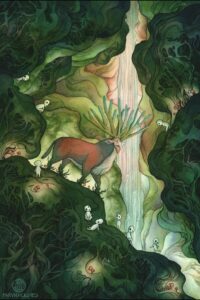
    Art depicting the Deer God and kodamas from Hayao Miyazaki's movie Princess Mononoke.
    Art by Calmality.

    Miyazaki seems to find redeeming goodness in every human with a face and a voice. The Word for World is Forest takes a much grimmer attitude, more like James Cameron’s Avatar (which owes an undeniable debt to both works under discussion). On the one hand, The Word for World is Forest still tells the story of humans who share both an affinity with the forest and with their own kind. But it also begins with a shockingly personal look at a few particular humans who care about almost nothing but their own power, making it distinctly unlike Miyazaki’s work.

    There’s an omnipresent attitude that the natural world has wisdom and wealth to share with all who touch it–human or not. This is where this novel and Miyazaki fans will find the most shared ground. The mystical, worshipful approach to trees and wind and water and sky lend themselves well to any fan of any film Miyazaki has directed.

    What it reads like: Princess Mononoke in space. So, a more fully-baked version of Avatar.

    5. Dragonsong by Anne McCaffrey (1976)

    Book cover for Anne McCaffrey's novel DRAGONSONG.

    Anne McCaffrey’s Dragonriders of Pern series is about time-traveling dragon riders fighting mycorrhizoid spores from space. However, the books are much more concerned with the mundane than with epic battles or interplanetary expeditions.

    Dragonsong is a prime example. It’s the story of a teenage girl who loves music–a craft reserved largely for men–and proactively cultivates her interests and abilities despite various roadblocks and fierce opposition from her family. Where other secondary fantasy might explore the relationships between kingdoms, Dragonsong spends time on mother-daughter and mother-father interactions. It’s not about pitting the protagonist against planet-breaking catastrophe. Rather, this novel explores the troubles of not doing your chores or getting your feet cut while wandering outside. And instead of populating the world with giant monsters, McCaffrey spends most of her attention on small, hungry fire-lizards that like to harmonize with the main character’s singing.

    McCaffrey’s writing tends to be more thematically heavy handed than many of Miyazaki’s films, but its focus on very real-world, everyday conflicts and concerns aligns it nicely with Miyazaki’s aesthetic. Dragonsong, in particular, is all about the interactions between humans and the natural world around them, with storms and seasons, waves and fish, lizards and dragons all engaging interestingly with the people of Half-Circle Seahold.

    What it reads like: Medieval Ponyo told by a narrator who’s willing to acknowledge the really poor parenting going on.

    6. Song for the Basilisk by Patricia McKillip (1998)

    Book cover for Patricia McKillip's novel SONG FOR THE BASILISK.

    The difficulty of accurately describing Patricia McKillip’s writing is in itself a shared characteristic with Miyazaki’s canon. Most of McKillip’s books–Song for the Basilisk included–are clearly works of fantasy, but that says little about what the experience of reading McKillip is actually like.

    Song for the Basilisk is a story about horrific trauma and devastating loss. The story unfolds with an ethereal touch that celebrates moments of beauty for their own sake, often making smaller stories out of these moments that might not be a story at all if relayed through another’s style and perspective–which is itself a point of connection between McKillip’s writing and Miyazaki’s work.

    Like several works listed here, Song for the Basilisk is also refreshingly complex in its unconventional relationships between active parties; there’s little clarity about who is really opposing whom in the end. Readers will still find heroes and villains, so to say, but not in all the places they might expect. This gives the book a unique break from the common mold.

    Very much like Princess Mononoke, The Wind Rises, and Nausicaä of the Valley of the Wind, Song for the Basilisk explores a deeply paradoxical relationship between violence and peace. Nausicaä, for instance, is a heroine who refuses to kill insects but who fights men and women with brutal ferocity. McKillip’s book connects violence to music, the very thing that gives healing and beauty to a cast of characters mourning immense loss.

    As I noted above, there’s no perfect match between Miyazaki and anything else. But this is a great starting point for Miyazaki fans looking for books like his movies.

    What it reads like: If Porco Rosso were about a singing competition instead of dogfighting.

    Character art for Nausicaa from Hayao Miyazaki's Nausicaa of the Valley of the Wind.
    Art by FF69.

    7. Spinning Silver by Naomi Novik (2018)

    Book cover for Naomi Novik's novel SPINNING SILVER.

    On its surface, Spinning Silver is a love story about a girl who tricks a magical being into thinking she herself is magical, or perhaps a bildungsroman about a girl making her way in the world long before she thought she was ready to (somewhat like Kiki’s Delivery Service). Like most fairytales and retellings, however, it holds much more story beyond that surface.

    Many things in this novel are never explained. Not unlike the singular phenomena at work in Spirited Away, My Neighbor Totoro, or even Porco Rosso, the events of Novik’s novel need no explanation because the novel isn’t about how these things transpired as much as it’s about the current state of the characters living in strange and wondrous worlds. It invites the reader not to worry about the mysteries behind the curtain. After all, there’s plenty to consider and admire right at hand.

    The looseness of Spinning Silver, as a retelling of another tale, is another area in which it reads like something Miyazaki might create. It leaves enough shared material to recognize its roots, but it also retains a unique enough shape that the original and the retelling can be wholly separate things, much as Miyazaki has done with his adaptations of Howl’s Moving Castle or Kiki’s Delivery Service.

    Last but not least, there’s understated, all but unobservable magic at work everywhere in this novel. As such, I think those who love Miyazaki’s worlds will find a lot to love in this one too.

    What it reads like: If the forest spirits of My Neighbor Totoro cared a lot about money and lived in Eastern Europe.

    I once sat with eight other people and watched Miyazaki’s first directorial credit, Lupin III: The Castle of Cagliostro. After watching the film, we discussed which Miyazaki film we each liked best overall. Eight people gave eight different answers. None of us could agree on a number one favorite.

    This experience left me with two overarching impressions:

    First, amazement that any storyteller could reach such a high level of excellence so many times; few narrative artists ever have.

    Second, that I need to find yet more stories like the ones Miyazaki tells. So please comment below if you know of more good books for Miyazaki fans!


    Get more nerdy content in your inbox:

    Sign me up

    * indicates required

    Intuit Mailchimp


    About the Author

    Headshot of epic fantasy author Stephen Taylor.

    Stephen Taylor is the author of The Witherclaw Trilogy as well as short fiction appearing in The Future Fire, MYTHIC Magazine, The Centropic Oracle, and other publications. His short story “Only an Ocean” won a Silver Honorable Mention in the L. Ron Hubbard Writers of the Future Contest. When he’s not writing, he’s often playing his violin or wandering in the woods.

css.php