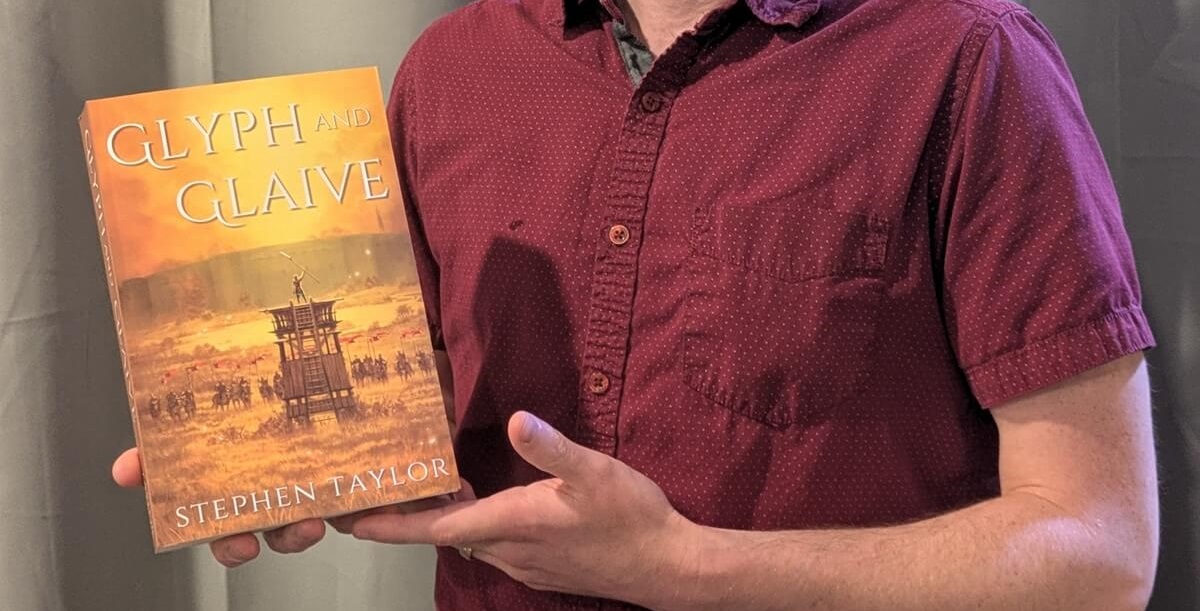
Rare’s the time that I write something here about my own books. But rare’s the time that I finish writing one. So, upon finishing work on Glyph and Glaive this year, I’d like to catalog a few thoughts on why I wrote it, what it means to me, and why I hope you’ll read it.
This will be a more or less spoiler-free look at the book, along with minimal references to Candle and Claw (the first book in The Witherclaw Trilogy). Here are a few items I’ll cover briefly below:
Glyph and Glaive is largely a war story. It takes place just over three years after the conclusion of Candle and Claw, with the Foneth-Redrem conflict in full swing. The central plot follows Jinaten ‘Tenswords’ Teserot, the senior military leader in Foneth, as she survives multiple assassination attempts and hunts for the ones responsible.
There’s the thing of the whole war getting more serious as well, not to mention new witches and Divine Order mages, more in-Foneth politicking, and multiple secret coalitions stirring up trouble near and far. But it’s mostly about Jinaten searching for answers as the clock ticks toward a major turning point in the war.
There’s a degree of continuity from the previous book. Key characters like Giovel Ullin and Varan Witherclaw appear within the first few chapters, for instance. There’s plenty of thematic continuity as well, with similar sub plots like witch hunts, glyph-building, and treachery rippling directly from the events of Candle and Claw. Glyph and Glaive is very much a sequel to book one, however. It doesn’t try to recap the events of the previous book or truly set the stage for newcomers. It’s supposed to stand on its own as a story.
Much of the plot relies on reader knowledge of the world and characters from Candle and Claw. Also, where Candle and Claw is chiefly Giovel’s story, Glyph and Glaive is mostly about Jinaten (who’s scarcely mentioned in book one). New readers will probably figure enough out to make sense of this book, but I recommend that you pick Candle and Claw up first.
Where Glyph and Glaive fits into the trilogy as a whole
I’ve done my best with this book to make sure that readers get a full story. There are plenty of threads left unresolved at the end, to be sure. But there’s no cliffhanger conclusion, and it follows Candle and Claw with enough space for it to feel like a tale of its own.
Glyph and Glaive advances several storylines from Candle and Claw, prepping for the big finale in book three. It also introduces new threads that have yet to be wrapped together at the trilogy’s end. So it’s several parts middle volume even as it stands on its own feet.
Key differences between Glyph and Glaive and Candle and Claw (and some similarities)
By virtue of having a new main character, Glyph and Glaive is a totally different story. But there are other big differences too, including:
There’s a lot less on-page magic
Readers will get a much closer look at the Foneth-Redrem war
The map moves to fewer new locations, mostly sticking in familiar territory, geographically speaking
The cast of characters is significantly larger
The plot is tangled in more political events than Candle and Claw features
And here’s a summary of the similarities:
Two returning viewpoint characters
As in Candle and Claw, Glyph and Glaive features points of view from multiple sides of the main conflict (protagonists and antagonists, if that’s not too simplistic to say)
Yulena centers heavily in the overarching story
There’s plenty of magical trouble and wizard cop stuff
What I hope you’ll get from reading it
There’s a lot I hope this book will do for readers. At the very least, I hope it moves the larger Witherclaw Trilogy story forward. But I set out wanting book two to top book one in at least some aspects—and I think it has.
On a more granular level, I hope readers like the new characters (Jinaten, in particular). I expect a few of you will enjoy the cat-and-mouse nature of the story. And my sense, from initial reader response, is that those who appreciated the thematic journey of Candle and Claw will similarly find a lot of satisfaction in where Glyph and Glaive takes its characters.
In sum
Thanks to all the readers out there. There’s one book yet for me to write, so I hope you enjoy Glyph and Glaive in the meantime.
About the Author
Stephen Taylor is the author of The Witherclaw Trilogyas well as short fiction appearing in The Future Fire, MYTHIC Magazine,The Centropic Oracle, and other publications. His short story “Only an Ocean” won a Silver Honorable Mention in the L. Ron Hubbard Writers of the Future Contest. When he’s not writing, he’s often playing his violin or wandering in the woods.
The fantasy genre has plenty of trilogies—and more than a few trilogies come with a weak middle book. In earlier years, particularly, the second volume was often more about setting the scene for the finale than actually delivering a full story. Plenty of trilogies just end book two with cliffhangers, almost as if to say that’s the only way to get readers into the next story. All’s to say that it’s probably more difficult to find trilogies where the middle book shines brightest than the ones where either other volume is the star.
The Dark Forest by Cixin Liu | Remembrance of Earth’s Past
Most people know Cixin Liu for The Three-Body Problem, which is a wholly fantastic book by itself. But the subsequent story is the one that truly amazed me.
The Three-Body Problem unfolds sort of like a hard sci-fi murder mystery, with a group of scientists, academics, and government officials searching for an explanation as leading scientists around the world continue to commit suicide. The quest for answers reveals that an alien civilization is just a few centuries from arriving to claim Earth as their own.
The Dark Forest picks up as earth grapples with the reality of this impending invasion. It features a similarly global (and even interstellar) plot, along with a similar group of scientists and world leaders. Where The Dark Forest really excels, however, is in the brilliant marriage of established science, theory, and plot. Its exploration of “cosmic sociology,” as the novel terms it, leads to a powerfully plausible finale and an unforgettable character journey for protagonist Luo Ji.
The following book, Death’s End, is yet another book I will never forget, but The Dark Forest is so strong by itself that you could almost end the trilogy here. I truly rank it #1 among #2 volumes in trilogies.
Book two epicness summary:
Amazing plot
Truly visionary science fiction theorizing
Deeply satisfying character journeys
Honing the ending in a way that feels like book two is its own book—not just a vehicle for the next one
Reading recommendation: It’s like Ender’s Game meets Foundation, so if you’re into hard science fiction with a sociological spin, you’ll probably like Cixin Liu’s Remembrance of Earth’s Past trilogy.
Mistborn: The Well of Ascension by Brandon Sanderson | Mistborn Trilogy
Brandon Sanderson’s Mistborn Trilogy continues to be among his most popular works (possibly the top). But the first and third volumes of the trilogy get the most discussion.
The first is very strong all around. The third is more divisive in that it’s a bold new direction for an epic trilogy like this. And so the middle volume is often overlooked. Here’s why I think it merits more attention.
Volume one delivers on plot, character growth, and Sanderson’s telltale magic system wonder. In The Well of Ascension, however, we really start to see Sanderson’s character writing skills go somewhere new. Not that I love all the characters on the page (I’m not a big Elend fan, personally). But Vin and Zane—a new character in this book—move the story forward in a much more interesting and thought provoking way than what we see in book one, and the plot gains a lot of strength from the new depth of these characters.
Last but not least, The Well of Ascension shoulder the question of what happens when the good guys ‘win.’ It shows the story doesn’t really end there—or at least doesn’t have to.
Book two epicness summary
Great new characters
Upping the ante for returning characters
Super Sanderson-esque storytelling around fantasy tropes
Reading recommendation: Sanderson’s Mistborn trilogy is a great mix of trope subversion, hard magic, and characteristically high octane action. If you like Brent Weeks’s Lightbringer series, you’ll probably love this trilogy.
Royal Assassin by Robin Hobb | The Farseer Trilogy
The last thing you want book two to be is forgettable. Well, Robin Hobb’s Royal Assassin is one book I’m confident I will never forget.
Royal Assassin builds directly on key events from Assassin’s Apprentice (the previous book in the trilogy), following the training and secret assignments of FitzChivalry while the Six Duchies contends with a brutal invasion from the Red-ship Raiders.
Much of the novel is about Fitz’s personal growth following a near-death experience in the first volume. What makes this book incredible is how willing Hobb is to up the stakes. She just keeps pushing Fitz into even more challenging circumstances than he has faced before. There’s no plot armor. There’s no magic bullet. Consequently, there’s no escaping the story unscathed.
The ending, in particular, is equal parts devastating and relieving. While the entire trilogy is well worth reading—because Robin Hobb always delivers powerful books—this volume packs more of a punch than any other Hobb book I’ve read.
Book two epicness summary
Aggressive upping of the story’s stakes
Continuity with the themes of the previous story while going new places all the same
Gripping character work
An ending readers won’t forget
Reading recommendation: If you like Robin Hobb’s Farseer Trilogy, you’ll probably also enjoy Lois McMaster Bujold’s World of the Five Gods or Tad Williams’s Osten Ard books.
Eldest by Christopher Paolini | The Inheritance Cycle
Looking at it today, Eldest is not the middle book in a trilogy. It’s book two of four. But I’m including it since it was the middle book of a planned trilogy when it first came out.
Eldest begins immediately after Eragon ends, following Eragon’s journey to develop his unique powers as the only dragon rider opposing an evil emperor. Its plot is fairly straightforward. Eragon trains and matures while his allies wage war against the empire. Where it really excels is in the small scale execution of the plot, taking key characters to new places (physically and emotionally) and exploring new themes. In essence, Eldest stands out for how it takes basic storytelling elements (conflict, character relationships, plot progress) and handles them really well.
Stakes are higher. The world is bigger. And there’s something of a new story in this volume itself, bringing key characters from a start to a middle and to an end. But most of all, it serves the longer storyline well by elevating the chapter by chapter experience over what the previous book offered.
Book two epicness summary
Growing the scope of the narrative
Containing a story within a story
Winning at the basics while playing the long game
Reading recommendation: A great place to go next, if you enjoy Christopher Paolini’s Inheritance Cycle, is Anne McCaffrey’s Dragonriders of Pern books.
The Elfstones of Shannara by Terry Brooks | The Sword of Shannara Trilogy
Terry Brooks’s Sword of Shannara Trilogy is unique, among epic fantasy trilogies, in how well each book stands alone. The first book has a beginning, a middle, and an end. So do the next two volumes—and like a great concerto, it delivers in each stretch of the journey.
The Elftsones of Shannara stands out, however, in how well it both opens and closes. It starts with a no-nonsense, major problem (a throng of very angry demons is about to break out of magic jail). The key conflict is obvious within just a few pages. Using an unconventional structure for the narrative, Brooks cleverly paces out the needed immersion into the wider story and large cast of the book, which is something that second books so often fail to do in fantasy.
It’s impressive enough to me that this book’s ending is as strong as the opening. Add to it that Brooks gives us an ending that demands a complex solution—not just a battle to beat the big bad—and the book propels itself much higher into the ranks of outstanding fantasy novels (and outstanding middle books among them). It’s a book that ends as if this is the end. Few writers have the bravery to close like that nowadays, or the skill to do it like Brooks does here.
Book two epicness summary
Moving on to tell a new story
Opening with power
Demanding complex solution
Closing the book as if it’s the end
Reading recommendation: If you enjoy Terry Brooks’s The Sword of Shannara Trilogy, you’ll probably also enjoy The Icewind Dale trilogy (or most Drizzt Do’Urden books) by R. A. Salvatore and The Riftwar Saga by Raymond E. Feist.
Dragonsinger by Anne McCaffrey | The Harper Hall Trilogy
Anne McCaffrey penned a particularly gentle story in her Harper Hall Trilogy. This trilogy follows a young girl named Menolly who befriends fire-lizards and writes songs. Dragonsinger picks her story up as she enters the famous Harper Hall to begin a more formal study of music.
There’s no time travel, so fans of MaCaffrey’s earlier Pern books might be disappointed. And there’s no epic conflict with a threat from space, so fans of her later books might be chagrined too. But anyone who has gone to school, been a teenager, or met a bully will find a lot that’s relatable and compelling in Dragonsinger. It’s a quick read, but it’s full of highs and lows that are true to real reader experiences.
I read this middle volume by mistake (thinking it was the first book in the trilogy) when I was a teenager, and the story swept me away even without the context of book one.
Book two epicness summary
Not waiting too long for the victories to come
Bringing early cozy vibes to fantasy
Gentle wish fulfillment fantasy for music lovers (like me)
Reading recommendation: If Anne McCaffrey’s Harper Hall Trilogy works for you, you’ll probably also enjoy just about anything by Patricia McKillip.
For more nerdy content like this, sign up for the monthly newsletter. It’s free to sign up, and you can unsubscribe any time.
About the Author
Stephen Taylor is the author of The Witherclaw Trilogyas well as short fiction appearing in The Future Fire, MYTHIC Magazine,The Centropic Oracle, and other publications. His short story “Only an Ocean” won a Silver Honorable Mention in the L. Ron Hubbard Writers of the Future Contest. When he’s not writing, he’s often playing his violin or wandering in the woods.
I recently read The Blood Stones by Tori Tecken—and not only was I lucky enough to get some of the author’s time to talk about the book, but I found a lot to love in this book. As part of my ongoing creator series, here’s a trimmed down version of the conversation Tori and I had.
Tori Tecken is a writer, reader, booktuber and the author of The Blood Stones (most recently) as well as the paranormal novel Phased.
I hope you enjoy the conversation! We did dig into a few spoilers for The Blood Stones, so I’ve included specific spoiler warnings where needed.
Here’s a quick breakdown of topics we’ve covered, with jump links for each main section.
Stephen Thank you for taking time to talk. I’m excited to discuss your book and writing and all things fantasy and science fiction fandom. I would love to hear, just in your own words, how you would want to be introduced.
Tori Absolutely. I am Tori Tecken, and I am an author, booktuber, mom. I am kind of in my second chapter of a writing career now. I was a child author when I was in high school, and now I’m kind of opening the next chapter of my writing life. My newest book is The Blood Stones. So that’s kind of the nutshell.
Stephen You’ve written in a few different genres, correct? And isn’t your current project something of a fantasy western?
Tori Yeah, I’m currently doing what I call a fantasy western because fantasy Yukon Gold Rush isn’t a subgenre yet.
Stephen Not that I’ve encountered.
Tori But it should be I think.
Stephen So epic fantasy with The Blood Stones, a western fantasy in the works now.
Tori Yep. And Phased is technically paranormal. I suppose it’s also urban fantasy, and young adult fantasy, so it kind of fits into multiple categories.
Stephen Well I know from your BookTube channel and such that you read across some varied genres. Before we get into The Blood Stones, I’d love to talk about sort of books and influences generally—just the types of stuff you like to read and how you identify yourself as a reader and fan.
Tori There are so many.
I mean, storytelling has been a foundational thing in my life since I was a kid. My grandfather is very much a storyteller, and I was raised listening to war stories of the civil and world wars. I think that foundational love of storytelling kind of led me to immediately look for anything I could get my hands on as a young reader.
My interest was really in stories with strong emotional impact. One of my foundational favorites was White Fang by Jack London. That was a big influence on me. Also Frankenstein by Mary Shelley.
This one’s going to sound funny, but I grew up watching Teenage Mutant Ninja Turtles and Yu-Gi-Oh! So those sort of blew open the fantasy and motley crew kind of aspect that I love so much now, not to mention friend and sibling themes, since those themes are big in both.
As an adult, I’d say probably my biggest two influences in storytelling up to this point have been Steven Erikson’s Malazan Book of the Fallen and Pierce Brown’s Red Rising books.
But truly there are so many authors and so many amazing fantasy series out there. I get anxious quite often because I can’t read them fast enough.
I’ve always been very inspired by movies as well. As you mentioned, I’m working on my fantasy western right now, and Young Guns—one of my favorite films of all time—is another influence. Yet another story with a motley crew, since I’m a big nerd for motley crews.
But really, any kind of genre, any kind of storytelling that brings me in and gives me that emotional impact with characters that I can really believe in is typically going to win me over.
Stephen This is really interesting, especially as I think about The Blood Stones. We’re going to have to come back to Teenage Mutant Ninja Turtles, because now I have in my mind this image of “what if the Bruhai were like the turtles?”
Tori Right.
Stephen And what if Thamujin was like Splinter, just a little meaner.
Tori You know what’s funny about that, actually? So master Lohi, when I was designing his character, I sat there and I was like, “How do I want to imagine this character?” And I came to: “If master Splinter was human and kind of evil.”
Stephen I split between reading and listening to the audio book, and a few voices sometimes made me think of Splinter in the older live action Turtle movies.
Tori Yeah, Andrew did a great job with the audiobook.
Stephen Well, before we leave influences behind, I’d love to talk Malazan for a minute and to hear how you first found Malazan, and whether you were one of the people who was all but told it was too hard up front. I’m one of those readers who put it off for almost 20 years after I first learned about the series, and I know lots of others have been intimidated too, but I finally started reading it last year. I just finished Memories of Ice, actually right before I picked up The Blood Stones.
Tori I’m really glad I didn’t know that. Those are big footsteps to follow.
Stephen No pressure.
Tori So I had kind of a nonconventional approach to Malazan. I was in college and I was just starting to get into adult epic fantasy. I had read Mistborn by Brandon Sanderson, and then I read The Godspeaker Trilogy by Karen Miller. Then a friend of mine, who was a big fantasy geek, handed me Gardens of the Moon in mass market paperback, which looks very non intimidating. And he said he thought I would enjoy it.
So that was my third adult epic fantasy read ever. I had no idea what was going on the whole time I read it. I was so confused. But it was also just amazing because it was so much bigger and more deep and introspective and poetic than anything I had ever imagined fantasy could be.
And when I read Deadhouse Gates shortly after that, it just became one of my favorite fantasy books of all time. The ending of that book in particular has stayed with me for over a decade. I won’t say anything for the sake of spoilers, for any blog readers who just have no idea. But I cannot get the ending out of my head still. It’s one of my top fantasy influences in terms of single novels. Ericson’s awareness of the human experience is just mind-blowing to me.
Stephen Light spoiler warning for The Blood Stones. I will tell you there were a few scenes in The Blood Stones—such as when Syndri and company are leaving, going out on the planes, and it’s looking a little desperate—that I really believed they were going to fail and get totally demolished. And I had a very similar feeling reading Erikson’s Deadhouse Gates. I thought, “Oh, they’re just not going to make it.” The odds are so stacked against them, to such an extent that I just didn’t believe they could survive.
And so it had a very strong impact that at least many of your characters actually make it out.
Tori That’s right. It’s always really encouraging when readers feel that pulled into the story. That’s really rewarding for me as the author.
Stephen I definitely want to talk about some of those high impact moments coming up, because there are some really strong ones.
Before that, though: Obviously a lot of people know about Stephen Erickson and Pierce Brown. But I would love to hear just briefly any sort of hidden gems books you love, books that are off the beaten path.
Tori Sure. I would say some recent ones that I’ve really loved include an epic fantasy series that I do not think gets enough attention for how incredibly masterful it is at character work—which is Daniel Abraham’s The Long Price Quartet. If you are a character-focused reader, it’s just incredible.
I would also say my favorite indie series right now is The Mortal Techniques by Rob J Hayes. It’s a very Wuxia, Asian-inspired kind of series. You’ve got samurai and vengeful spirits and lots of appeal for people who grew up loving shōnen anime. It’s like candy for adults.
Other than that, some of the best world building I’ve read recently has to be Andrew D Meredith’s Kallattian Saga.
I also really enjoyed Daughter of the Forest by Juliette Marillier. It has kind of a fairy tale fantasy vibe, and her character work again is just beautiful. I actually just got a chance to talk to her on my channel in March. She’s close to 80 now, and she’s just an incredible wealth of writing philosophy and knowledge in addition to being just a wonderful writer.
Narrative structure in The Blood Stones
Stephen Thanks for sharing these. So I’d love to dig deeper on your book now. One of the first things that really struck me with The Blood Stones was the structure of the book. Light spoilers ahead once more.
We’ve got an opening section that happens, and then another section that happens about three years later, and yet another section that happens about three years after that. Structurally, it reminded me of works I’ve read in the 80s and 90s, like some of R. A. Salvatore’s earlier books. But not a lot of recent works do the same kind of smaller story sections spread over time. How did this time jump structure come about with The Blood Stones?
Tori So when I originally started writing The Blood Stones, it was going to be a single POV, just Gehrin’s point of view. And I got about three chapters into the book before I realized that that was a horrible decision because Gehrin on his own couldn’t tell the full story. It was too big for him. I wanted his POV to bring the feeling that he’s so much smaller than the world around him.
In terms of structure, I think that’s where I can kind of tip my hat to the influences like Steven Erickson. When I read the first few Malazan books, it kind of jostled me out of the concept of “this is what a fantasy book looks like.” And it gave me a chance to kind of rethink and realize that I can do whatever I want with my book, and I can make it work with whatever story I’m trying to tell.
For instance, I love a good warrior school trope. I love it. But what I don’t love is hundreds of pages of training montage. Hate it.
So I was trying to figure out how to give the reader moments that are really important for building up these characters, and I wanted to strip away all that excess exposition in the montages—the things that at the end of the day are just words and extra pages without driving us further into the heart of the characters.
I fought with the overall timeline for months, because at first there’s a character that we don’t get introduced to until Part Two. And at first I had that character introduced right away, which didn’t work because then that character was so much older than Gehrin. By the time we got to the end of the book, it was a big mess. So I kind of just organically let it be what it was.
I got to a stopping point where I needed to jump ahead, and I just did it because that was the story I was telling, that that’s what felt the most true to the characters, and the story was ready to move forward in time.
Stephen I love that. I feel like there’s way too much writing lore that advises against time jumps and tries to formalize everything. As if, when doing multiple POVs, you need to strictly alternate one chapter with character X and one chapter with character Y. And I don’t think that usually works.
Maybe this is too far future, but while we’re talking timeline, I’d love to hear if you expect there to be similar time jumps for other Legends of the Bruhai books.
Tori It sounds weird, but I’m a discovery writer in the sense that I feel like the relationship I have to the story is that those characters come to life, and I’m bringing their lives and their stories and their voices to a page. If I get to a point where I feel like a time jump is necessary for the story that I’m telling, I’ll use it. If I don’t, I won’t.
I don’t know, in book two, that I’ll need a time jump like that. There’s a lot that needs to happen, and there are a lot of convergences, ramping up of conflict, as you might expect coming off of the end of book one. Books two and three are all sort of one giant conflict, unlike book one, so that will affect the structure a lot.
Stephen Can you speak to the youth of the characters and how that affects the overall story shape? Like how you said you didn’t want the one character to be too old. To me it feels like the three most central characters in The Blood Stones are going through a similar coming of age journey, even though their lives are so different.
Tori I have lots of thoughts on this topic actually. Coming of age stories are one of my favorite tropes in fantasy. It’s also a trope that rarely works for me. Maybe I’m just more picky about it, but I think that there’s something really powerful when you have a world that is just this epic scale, filled with these very adult conflicts that are vast and difficult, but when you get to see the world through the eyes of a young character who’s being thrown into an adult world that they’re not ready for yet.
I think it offers you a lot of opportunities to look at things instinctively and viscerally. Syndri’s character, I think in a lot of ways, represents that kind of visceral reaction to the world that we’re in. Writing her character was very fast and instinctual because of who she is as a person. Versus Gehrin, who’s trying to do the right thing and is carefully taking steps and thinking through each action that he takes. And Xario kind of represents an in between balance, like there’s they’re all coming at this from different perspectives.
One of the reasons that Master Lohi has so few chapters in the book is because he knows too much. I didn’t want the reader to feel like the world was smaller because master Lohi knows so much more of it. But with young characters, you can drive that feeling that the world is just so big and overwhelming.
But The Blood Stones is still very much an adult novel, because the world is not being made smaller to fit the perspectives of the characters. They’re being thrown into a world that’s far too large for them instead.
Stephen As you described it, it just made me think of the portal portal fantasy premise of finding an easy way to show the world from a fresh perspective. You know, the idea of creating a character who doesn’t know anything about the world so there’s a natural reason to describe it and explore it.
Tori Right. Of course, Gehrin doesn’t know all these things, of course, even Syndri doesn’t know much, since her world is so insular compared to a Lohi or another character.
Stephen So I thought a few times of other adult books with characters training to become elite kinds of guards—like The Lightbringer Series by Brent Weeks, which I really love. These characters have really interesting but prolonged philosophical reactions, moral reactions to what’s happening in the world around them. And I thought it was really interesting how simple and sort of innocent it seems like Gehrin feels while having these experiences—and doing things that probably feel horrible to him. But rather than having three pages of feeling horrible about himself, which is common in a lot of adult fantasy, he kind of moves on without much direct commentary.
Tori Exactly. I think part of this is because when you have young characters who are dealing with highly traumatic situations, a very normal reaction, in order to survive it, to compartmentalize and put the experience away somewhere. Your psyche is not going to stand up to much of that kind of trauma otherwise.
I was very interested, especially with Gehrin, to examine childhood trauma. How that’s dealt with in a young character internally, and how that all sets him up for character arc moments that are coming for him in the rest of the trilogy. Likewise I’m interested in exploring how that will somehow manifest when he’s older.
High-impact moments in The Blood Stones
Stephen That brings me right back to moments that hit really hard in the book. One of the scenes that hit me hardest was (spoiler warning once again), a scene early in Part Three. Tirrim is making this big decision, and it’s happening in this place that Gehrin and others sort of associate with bad, compartmentalized memories. And then Gehrin has to confront him about this decision in that same place. It feels like even here, at the oldest Gehrin is in the book, he hasn’t figured out how to deal with all this other stuff other than just to leave it in the forest.
Tori Yep. And that’s part of what makes Gehrin so malleable for characters like Master Lohi and Thamajin, right? They’re taking advantage of that in a way, of the fact that Gehrin hasn’t gained enough of himself yet to drive his own purpose and to step out of that kind of expected behavior. He has been kind of formed and forged by these older characters that know so much more about the world than he does.
Stephen Yeah, and I think that is part of why the scene hits all the harder, without needing a bunch of reflective, sifting through—
Tori Navel gazing?
Stephen Totally. So that’s a scene that hit me hard. I’d love to hear your perspective on a few of those scenes that you really wanted to make an impact and be specifically unforgettable.
Tori Sure. I’ll go through a couple of them.
The most edited scene in the entire book, is the very first one. Partially because that scene is such an important metaphor for a lot of the series as a whole, and it shapes so much of the rest of the story, especially with Gehrin’s character moving forward.
It was so important to me that every detail of that first scene was poignant and came across exactly the way that I wanted it. I think I rewrote the first scene eight or nine times. I wanted to hook the reader in right away at the beginning, but I also wanted this scene to be something that, when readers finish the whole series, that they can hearken back to and see the through lines all the way across three books.
Spoiler warning. In the middle of the book, when Syndri makes her very impulsive decision to kill another character, and the ramifications of that ending of that chapter—where she realizes what has happened and she takes action—this is another one for me. It was a really hard scene to write because Syndri is such an easy character to really get wrapped up in when I’m writing her. And it was such a gut punch for her character that I really felt it when I was writing this scene.
Later on, I think Gehrin’s first kill was a big one too. That one was probably the hardest scene for me to write in the entire book because, like you mentioned earlier, there’s an innocence to him that I think he still has to some degree, but there’s a really major break of that innocence and the first big sign of severe compartmentalization that he has to utilize.
Stephen On the note of compartmentalization, I think there are a lot of writers who wouldn’t even go there with a child character or even with an older character in plenty of cases.
Tori I think it’s reminiscent again of the kind of metaphor behind the scene. There’s a child being asked to step into an adult world that they’re not equipped for. And in a world that no one is ever equipped for, really.
And I wanted to show this brutal world through the eyes of a character who is so small. It was a slow process getting through this scene because it had to be really impactful, but it took a lot out of me as a writer as well.
Stephen A few of my other favorites were the scenes with characters who get less page time, actually, like King Kinhariian and Xario. Their conversation was one of my very favorites.
Tori I love that scene.
Stephen I think their conversation makes them both feel like real people in a way we couldn’t have without that short little exchange.
Can you tell me about characters you loved writing who aren’t necessarily viewpoint characters or the ones with the most page time?
Tori Yes. Any of the other Bruhai boys are an easy answer. Kajen specifically is great fun to write. I love him to bits and pieces. He’s the street urchin to Gehrin’s nobility, and I’m a firm believer that any good motley crew has some very sharp contrasts in it. You know it’s the Donnie to Raphael contrast. And then they all get put together in a little box and they have to play nicely. So Kajen was a big favorite of mine to write.
I would say within Syndri’s point of view I really had a good time writing the sibling dynamic, both with Senna, but also with her little brother Baya there. I was glad to get some little moments of sibling normalcy, which I think brought some humanity to a very barbaric culture and a storyline that was really important.
Stephen It feels so rare to see depictions of families of more than two siblings in a book, even just three, you know, and you’ve got a few examples here, with Gehrin and Syndri. It was also nice to see a family with both parents present on page, since that’s hard to find in orphan farmboy epic fantasy—and in most genres.
Tori Exactly. I mean that was one of the reasons why Ettlan survives. I was thinking of stakes for these characters, and death isn’t truly the worst you can give to most characters. So I love what that family dynamic allowed me to explore with Ettlan’s condition and how Syndri is being forced to relate to her differently now.
And it also opens the door a lot for Gehrin and his two brothers. I mean, with Xario and Gehrin there’s a discomfort between them that offers something interesting.
One other character was great fun to write, who only comes into a few scenes in the first book but will feature more later, is Itaki, who is the school brat, bully kind of character. And as he gets older, he’s this very slick guy who sort of has the court figured out. He’s kind of a slime ball. But I enjoy writing his character a lot.
Sneak peek: Future Legends of Bruhai Books
Stephen That little hint for book two is a great jumping point. Can you share any sort of sneak peek into future Legends of Bruhai Books?
Tori Well, book two, The Queen’s Wolf, is in the works currently. As might be expected, there will be a convergence of some storylines and a reconvergence of some other storylines that I’m really looking forward to.
A lot of people talk about The Blood Stones being kind of a set up to whatever’s going to happen in the next couple of books. And the explosion that I think a lot of people are waiting for is definitely going to be much more present in book two.
I’m very excited to get into it.
As for the trilogy itself, I’ve known where it’s going to end since I started book one. It’s actually the prequel series to a series that I started over a decade ago in college, which happens about half a generation after Legends of the Bruhai.
Eventually, when everything is said and done, there will be Legends of the Bruhai and then there will be a bridge novella that’s going to go back several thousands of years to show the story of where the magic went.
Stephen That’s a great sneak peek.
Tori I’m excited about it. I can’t write them fast enough.
Stephen Well, as you said, fortunately there’s plenty of great stuff to read in the waiting time.
As you look ahead at these books, having the end in mind, I’d love to hear in your writing process and craft, where you start populating the story—whether it’s with the world itself or characters. Where do you start?
Tori For me, character is almost always the heart and soul of everything I write. I say almost always, but in honesty it’s always.
This whole story started because I was doing some back story work on some characters for the second series, and I realized I had this kind of image in my head of this young boy and this culture that’s kind of adjacent to the series I was working on. So here was this young boy watching an execution, and I thought about how he would feel and how that would change him as he was growing. And that just exploded the entire story of Legends of the Bruhai, because I knew I’d always wanted to write a military school style motley crew of warriors. Gehrin was the catalyst for the entire trilogy, and the world just kind of kept expanding and building from there.
First his family showed up, and then it just kept building and building until you have this massive culture of people and all of this organic movement going on between the characters there. And then you have to figure out how to make it somewhat cohesive.
Stephen So as a discovery writer, could you share any moments of that discovery process that you were especially excited or proud about?
Tori Yeah. Syndri didn’t exist until almost the point where I added her into the book. I was writing the three perspectives that I already had up to that point, with Gehrin, Xario, and Master Lohi. And then I realized that I wanted a perspective from outside of Katesh and everything that was going on politically with them, because I’m a big believer that there’s a ripple effect. Everything we do or everything a country does ripples outward, and it affects other places and other people that sometimes you wouldn’t even think would be affected.
I knew that Syndri’s country was full of tribes of horse lords, and I wanted to play with that. I’m a big horse fanatic and so I opened the chapter that I was going to write and Syndri just appeared on the page, with her headstrong, kind of subversion of a strong female character. I wanted to combat the idea that we see so many of these very one-dimensional characters that are just strong female characters with big swords. And I wanted Syndri to be strong but also to be sort of a mess. She’s not actually the strongest woman in her little group, even in her family. She’s very impulsive and selfish, and I wanted to explore that kind of a character a little bit and see how I could break that trope down. So in very Syndri fashion, she just kind of charged onto the page and there she was.
Stephen She’s definitely not a Mary Sue, and I think the contrast between her and her mom and of course, Senna, shows clearly that Syndri’s just her own person. Discovery and all.
Okay. One final question. What else do you want readers to know about the book now that it’s been out for a little while and you’ve had a little time to see how readers have responded?
Tori Well, the first thing I have to say is that I really, honestly want to thank everybody who has opened this book because, like we’ve talked about, there are so many amazing books at our fingertips.
Stephen I could have read Malazan book four.
Tori I know! I still can’t believe that I had to follow Memories of Ice and all its goodness. I’m so glad you liked the book.
But I’m really grateful, because as an author it’s very vulnerable to put your work out there and hope that people read it and resonate with it. So I’m grateful for all the people that have really embraced these characters and fallen in love with them.
The story I’m telling is really my love letter to everything I love in fantasy. It’s my first published epic fantasy, and I’m very proud of it and of course so glad that it seems the characters are really resonating with so many people out there. That’s really rewarding.
As an author, there’s nothing that makes me want to keep writing more than that.
For more nerdy content like this, sign up for the monthly newsletter. It’s free to sign up, and you can unsubscribe any time.
About the Author
Stephen Taylor is the author of The Witherclaw Trilogyas well as short fiction appearing in The Future Fire, MYTHIC Magazine,The Centropic Oracle, and other publications. His short story “Only an Ocean” won a Silver Honorable Mention in the L. Ron Hubbard Writers of the Future Contest. When he’s not writing, he’s often playing his violin or wandering in the woods.
Terry Brooks was perhaps the first “epic fantasy” author I ever read. Since I was a teenager, his books have maintained a distinctly positive place in my mind for that alone. As I recently picked up The Elfstones of Shannara (which I first read at age 16), I wondered how it would hold up for me personally, given all that I’ve read and the life I seem to have lived since then.
I sort of expected Elftsones to disappoint me here or there. Books I loved as a teenager often do nowadays. I also wasn’t sure how well my own tastes would take to it now, after more than five years since I’ve read any of Brooks’s work. Not to mention that I really didn’t like the MTV adaptation of the book, further upping my reservations about a reread (once the elf DJ put on Coldplay during the magical Ellcrys ball, I sort of stopped believing).
Caveats and concerns aside, my Elfstones reread reminded me just how powerful Brooks can be as a storyteller. I loved the book the first time around, and I loved it much more this time.
Here are a few reasons why.
The Elfstones of Shannara has an amazing opening
Brooks has written several striking starter chapters through the years, but Elfstones stands at the top for me. The very first scenes accomplish a great deal of worldbuilding, set up the key plot challenges (a magical seal that has held demons in check for millennia is now fading), and get fairly deep into the mind of one of the book’s most interesting characters.
This opening hooked today-years-old me and pulled me right back into the Four Lands, even after my many years away.
So many recent epic fantasy novels err on the side of not taking time to properly ground the reader—and so many back in the day took too much time setting the table before any story starts happening. Yet Brooks manages a wonderful, readable balance right from page one. Not every chapter does it quite so well, but it goes a long way to get such a compelling, craft-smart chapter right out of the gate.
Elfstones has a unique and compelling structure
The first chunk of the book follows Ander Elessedil and then Allanon the druid, giving plenty of plot and high stakes without ever meeting Wil or Amberle—whom I recalled being the real heroes. The Elftsones of Shannara is somewhat like The Lord of the Rings in how it alternates mostly in large batches of chapters, leaving similarly large breaks before you get to continue with another storyline.
Tolkien’s structure doesn’t work for every reader. But by establishing a more regular cadence of story juggling, Brooks gets the benefits—longer stretches to really get to know the characters and appreciate each sub group’s challenges—along with the big book feeling of having multiple plotlines unfolding in parallel.
One of the most interesting aspects about Elfstones is how little the viewpoint characters in one storyline know about the ones in another. It really helps up the stakes, since they’re all in the dark at the same time the reader is, which is not the case in The Lord of the Rings or many other books that alternate between characters at a more conventional pace.
There’s a lot of sequel power in The Elfstones of Shannara
Brooks’s first book (The Sword of Shannara)is somewhat famously similar to The Lord of the Rings, and not in terms of structure as referenced above. The plots and character groupings are remarkably alike. In fact, these similarities are the number one source of criticisms for Brooks’s debut.
That said, The Sword of Shannara made a huge impact on fantasy as a viable ‘genre.’ The pressure was on when Brooks wrote Elfstones. Add to that pressure: a) Brooks writing half of a totally different novel and having to scrap it; b) Brooks having to rewrite half of Elfstones for his editor after finishing the first draft; and c) general challenges making the middle book of a trilogy as strong as the first or third, and you have quite the recipe for a boring old book two of yesteryear.
Instead, Brooks brings true sequel power—taking what was good and making it better while offering a truly new story. Very little about Elfstones feels like a repeat of Sword’s initial success. Brooks truly pushed himself into new territory with this one, and it pays off big time for readers because the story, character, and setting all stand on their own.
And that might be one of the core strengths in The Elfstones of Shannara. A reader can pick it up without having read the former book. That reader can get a whole story in this single volume. There are clear rewards for reading book one first (and book three after). Yet this is one of those rare trilogies that doesn’t require 100% follow-through to get a complete story.
Killing the villain isn’t the solution in Elfstones
Most epic fantasy ends with a violent solution. Defeat the baddie and the problem is resolved. This was one of Ursula Le Guin’s biggest complaints with the genre (for something wholly different, explore her Earthsea Cycle).
Elfstones is about as martial as most epic fantasy, with several large-scale battles and numerous smaller ones. But we find out early on that the plot needs a resolution other than being the best warrior. Furthermore, Brooks fulfills that promise. He does it both through the development of the plot and via key characters like Ander, Amberle, Wil, and even Allanon.
Spoiler alert: Allanon does kill the baddie. And the fight keeps going.
Brooks’s offers a much more interesting solution in the end. Instead of killing something, the heroes solve the problem by growing something. I wish I had a few dozen more epic fantasies that use creation as the solution to destruction. (Again, read Earthsea if you want this too; Sean Russell’s Initiate Brother Duology is another great example).
The Eflstones of Shannara has a hard-hitting ending
Last but least is the last. Elfstones brings it home with a fantastic ending. This is shockingly rare.
Epic fantasy, as a genre, tends to lack strong endings. You’d think people would copy Tolkien more and give the ending time to breathe. Yet so many epic series rush to the finale and fail to deliver much beyond a big battle. This might not be such an egregious sin. Except that some of these series have pulled readers along for thousands of pages, all for a lackluster moment that doesn’t deliver on what readers really want.
Elfstones isn’t most epic fantasy. It wraps up several carefully introduced themes. The story sees every major character through to a critical arrival point. It ties loose ends briefly but powerfully. There’s even a hint or two at more story to come without requiring the reader to press on.
I wish for more epic fantasy with journeys like the ones in Elfstones. And I’d love to read a few more that pull the ending of the journey off so well.
For more nerdy content like this, sign up for the monthly newsletter. It’s free to sign up, and you can unsubscribe any time.
About the Author
Stephen Taylor is the author of The Witherclaw Trilogyas well as short fiction appearing in The Future Fire, MYTHIC Magazine,The Centropic Oracle, and other publications. His short story “Only an Ocean” won a Silver Honorable Mention in the L. Ron Hubbard Writers of the Future Contest. When he’s not writing, he’s often playing his violin or wandering in the woods.
Almost from the first time I heard of them, I was told to tread with caution where Steven Erikson’s Malazan books are concerned. Even his diehard fans say this series is hard to read. Some even intimate that The Malazan Book of the Fallen (the series’ official name) is the most difficult epic fantasy series to read of any written by a living author.
I was about sixteen when I picked up the first volume. I backed off after just a page or two. This was mostly thanks to accounts of the Malazan learning curve—and not actually due to anything I was reading. Now, four books into the series, I seriously wish I’d pressed on instead of moving on in search of simpler series.
Malazan isn’t really so hard to read. It’s complex, to be sure, and Erikson doesn’t hold readers’ hands like some other authors do. But I’m convinced that thousands of epic fantasy readers are missing out because of exaggerated reports about the challenges of reading this series. Many readers also steer away, unfortunately, because of the vigor of Erikson’s valiant fans, who can, in their zeal for the books, often attack and insult potential readers.
I believe there’s a lot of happy middle ground, so here’s my take and TLDR pitch for the series: If you love unique epic fantasy, you should seriously consider reading Malazan. It truly isn’t that hard to digest—and there’s assuredly as much to admire as Erikson’s fervent fans proclaim.
First, some background and a few notes on the Malazan learning curve.
What is the Malazan series about?
Malazan is a story about: godlike beings breaking free from their imprisonment; an empire crumbling, rallying, and redefining itself; a squad of veterans fighting to survive; individual people struggling to stay individuals (not just pawns in ascendants’ hands).
Readers often have a hard time describing the plot because there are, in fact, many plots. In fact, the interweaving of so many is one of the sources of difficulty for most readers, although most Malazan storylines by themselves will feel plenty familiar to fantasy readers.
Is Malazan really that difficult to read?
This is a legitimate question. Here are some of the things real world readers say about Gardens of the Moon (the first book in the series) in Amazon reviews:
“Erikson seriously erred beginning this story in medias res.”
“What I found… was a turgid, impenetrable mess.”
“Everything stops reading like nonsense about halfway through.”
“Things seemingly come out of no where [sic]. No explanation. No rules.”
“The book is too difficult.”
And here are a few comments from experienced reviewers:
Library of a Viking: “I barely understand a single thing.” (commented in the middle of book two.)
Daniel Greene: “This is for epic fantasy fans only.”
Bookborn: “I thought I was too stupid for the series.”
I tend to disagree with the tenor of the comments above. But coming to grips with Malazan is obviously a challenge for many smart readers.
Sign up for the newsletter
Get the latest articles and updates on The Witherclaw Trilogy with Stephen’s monthly newsletter. Subscribing is free and you can opt out whenever you want.
Some authors tell you three or four times how everything works in their fantasy settings. Erikson respects reader intelligence a lot and spreads his telling more thinly. Sometimes he lets you figure things out all on your own, which can make it difficult to read Malazan.
Easy example: Characters in Malazan refer often to the unfortunate dead crossing Hood’s Gate. Erikson doesn’t sit down and go into expository detail about Hood being the god of death or his worship being one of a few sanctioned religions before the Malaz conquest of Kartool Island. He generally just lets characters say things like, “He’s already at Hood’s Gate.” There’s enough context to figure out quickly what these characters really mean.
Not so simple example: Erikson famously assumed hordes of readers would deduce the identities of several new ascendants (gods, more or less) based simply on the timing of their ascent. In book two or three he says outright, “Those new ascendants are in fact such and such characters.” I read book one and most of two without ever putting the pieces together. That’s how it goes for almost all Malazan readers out there. (Sidenote: it doesn’t actually matter whether readers picked up the hint or not. The plot still makes plenty of sense up to the point that Erikson does share the information more forthrightly.)
Malazan readers do still need to come to grips with a lot. There’s a vast high fantasy setting, with a big cast. The world has unique races, a large pantheon of important players, and an incredibly important magic system. All without much overt guidance from the author. The thing is, Erikson anchors the reading experience so expertly that you don’t need to know everything. Not by a long shot. His effective use of prose, characterization, and plot go a long way to proofing his books against gaps in reader memory or notice.
You get some whole stories without reading to the end
Another chief way Erikson offsets the learning curve is by giving a solid ending with just about every book in the series. Malazan stands head and shoulders above many other truly great works of epic fantasy by delivering substantive stories without requiring quite so much of the reader’s blood to access each one.
Gardens of the Moon, for instance, has a beginning, a middle, and an end. It doesn’t have all the endings it could have. But it provides a satisfying stopping point for readers who decide they’ve had enough. Deadhouse Gates (book two) does this even more profoundly, finishing a few amazing stories while continuing and beginning others. It strikes a balance sort of halfway between Terry Brooks’s original Sword of Shannara trilogy—in which each book ended its own tale more or less completely—and Brandon Sanderson’s Stormlight Archive—in which each book has a strong conclusion without closing many doors.
So. If the idea of a 10-book series scares you, take comfort. Malazan is a much safer, less difficult investment than The Wheel of Time, A Song of Ice and Fire, The Sword of Truth or many other peer series. You can bail out at the end of almost any book and you’ll still get some solid, whole stories.
Malazan’s greatest strengths are tied to its moderate difficulty level
One of the things that amazes me most, having read just a quarter of the series so far, is how much story Erikson has already packed in. The pace is unyieldingly quick, with major events advancing in every chapter. Part of the genius of the books is how much Erikson elects to skip. Other authors might fall into the trap of overexplaining or making sure it’s all crystal clear (e.g. where other authors often do overexplain or overemphasize). Not Erikson.
It’s surprisingly like William Gibson’s Neuromancer in this way. So much happens so quickly, often with little contextual information shared in the moment. But the heart of the story is clear without much context anyway. Truly, the author’s choice to skip the boring parts doesn’t hurt. It just keeps things interesting.
Difficulty level or no, Malazan sets an unfathomably high bar for epic fantasy
The biggest reasons to read Malazan are, of course, not about the level of difficulty or the time commitment required to read it. You should read the series because the books are amazing.
It’s not great because of the 700 character-cast. It’s great because of the depth of human insight they bring to the story or the riveting relationships those characters form.
The series doesn’t need the careful stitching together of 30 different plotlines to be exciting. It’s exciting because of the quality of storytelling in each smaller story Erikson develops.
Malazan isn’t about Erikson’s obvious love for history, either, regardless of the hundreds of thousands of years of lore bleeding onto the page. Malazan is about being transported to an unforgettable setting.
It’s bigger than The Wheel of Time and richer than Memory, Sorrow, and Thorn—with a larger world, a stronger history, deeper cultures, and a more lively cast of characters. Its moments of breathtaking heroism rival anything in the genre, from The Lord of the Rings to Elfstones of Shannara to the Lightbringer series. The deep human insight pervading these books is particularly unique, measuring up with the best of Robin Hobb, J. V. Jones, Sean Russel and many other top tier fantasy authors. In short, there’s something outstanding here for just about any epic fantasy reader.
Conclusion: Epic fantasy readers should seriously consider Malazan
I first learned about Erikson thanks to a Terry Brooks fan forum. It was in this same forum that I—as a hungry young fantasy reader—first heard of R. A. Salvatore, Anne McCaffrey, Guy Gavriel Kay, Naomi Novik, and many other authors old and new alike.
Everywhere Erikson came up, his work was regarded on par with Tolkien’s The Lord of the Rings and George R. R. Martin’s A Song of Ice and Fire, often with no competing comparisons. It was this consistent attribution of quality that finally convinced me to try Malazan again after 15+ years since my first attempt.
From where I am, a mere 25% through the series, I genuinely believe those claims.
Reference information
The number of named characters in the Malazan series: Malazan has about 700 named characters. For comparison, A Song of Ice and Fire has about 1000 so far, and The Wheel of Time boasts a whopping 2700.
Word count of the Malazan series: All told, the ten books in this series total about 3,325,000 words. That’s about three times as long as the entire Harry Potter series and a million words shy of The Wheel of Time.
Publication history of the Malazan series: The entire 10-book series was published between 1999 and 2011, averaging close to 15 months between each book.
FAQs
Why is Malazan so hard to read?
Steven Erikson’s Malazan is not as hard to read as many reviewers describe it. However, the series is long and complex, with a massive world, a many-layered plot, and a huge cast of key characters. Malazan also forbears from many instances of repeated explanation. The lack of expository reminders puts more onus on readers to remember what they’ve already read.
Is there an easy way to read Malazan?
Malazan is best read in publication order. Whether readers move immediately on to the next book or not, it can be helpful to review the dramatis personae included in most publications of the books. Fans have created a dedicated Malazan Wiki, which also helps readers refresh core details between books.
What’s the best reading order for Malazan?
Although the timeline jumps back and forth in parts, Malazan Book of the Fallen is written in strict order from books one to ten. The simplest reading order is in order of publication. Subsequent connected works like The Kharkanas Trilogy (a prequel trilogy) or The Tales of Witness (a sequel series) are best read after the main series, since these books offer spoilers into key events of the main series.
For more nerdy content like this, sign up for the monthly newsletter. It’s free to sign up, and you can unsubscribe any time.
About the Author
Stephen Taylor is the author of The Witherclaw Trilogyas well as short fiction appearing in The Future Fire, MYTHIC Magazine,The Centropic Oracle, and other publications. His short story “Only an Ocean” won a Silver Honorable Mention in the L. Ron Hubbard Writers of the Future Contest. When he’s not writing, he’s often playing his violin or wandering in the woods.
I don’t love it when creators turn one good idea into a massive franchise (let alone one bad idea). But I’m also a sucker for a sequel. I especially love sequels that do their own thing rather than trying to repeat a formula. Christopher Paolini’s recent novel Murtagh is one such sequel.
If you’ve read elsewhere on my blog, you’ll know that reading Paolini’s Inheritance Cycle has had a lasting impact on me. I encountered the first two books as a teenager—struggling to finish my own first novel at the time—and eagerly awaited books three and four after that. I read Murtagh (which is flagged as a World of Eragon novel rather than a run of the mill sequel) with similar eagerness and am glad that I did, as I’ll explore in a more review-like structure than I’ve used in this blog before.
Because I’m looking at this very much as a book for people who’ve read The Inheritance Cycle, you’ll find some series spoilers below. I won’t, however, spoil Murtagh itself. Caveats, also: If you didn’t like The Inheritance Cycle, you probably won’t like Murtagh, which might mean this article isn’t for you either. But then again, maybe I can change your mind.
Murtagh shows us a different Alagaesia
Quick summary, for starters: Murtagh takes place after the conclusion of The Inheritance Cycle, when Murtagh (the character) is pretty much an outcast everywhere for his role in Galbatorix’s rule and demise alike. The Varden hate Murtagh and Thorn for fighting them in nearly every major battle. The dwarves hate them for killing their king. And for good measure, loyal citizens of Galbatorix’s empire hate them too—even though their role in bringing Gabatorix down doesn’t seem to be well or widely known.
With this backdrop, Murtagh and Thorn embark on a series of adventures to confront a new threat to Alagaesia. Part of this is about trying to do something good for the people they’ve stymied or outright fought in the past (like Nasuada). The journey is also about Murtagh and Thorn looking for where they belong now, given the huge changes they’ve brought to the world around them.
Despite events from the previous four books having huge bearings on everything about Murtagh, this book does its own thing in a few major ways:
New plot and story shape. Murtagh tells its own unique story, rather than recycling previous plot lines (which I would have hated). It also manages to feel like an entire story in one volume—even though much is left open at the end. One of the things that most impressed me about the book was how self-contained it feels, even given the huge amount of story preceding it.
New magical goings on. Paolini spent a significant amount of time establishing the magic system in The Inheritance Cycle, and that setup rewards series readers with some dynamic new ways magic can be used. On the one hand, this is cool and interesting. On the other hand, it also helps up the stakes and build character for Murtagh, whose magical training was very different from Eragon’s.
New locales. While a chunk of the book is set in places we’ve seen in previous books, Paolini breathes a lot of new life into return locations. He also shows us plenty of new and vibrant settings, all while maintaining a sort of worldbuilding aesthetic that feels fully harmonious with The Inheritance Cycle.
New faces and forces at work. New characters like Lyreth, Bachel and Uvek (my favorite of the new faces) go a long way to making Murtagh feel like its own thing. Unsurprisingly, this book also offers a lot more depth and relatability for both Thorn and Murtagh themselves, particularly in their journey from being total loners to learning what it means to play nice with others.
A different kind of story for different kinds of characters. The dragon-rider relationship is central to Murtagh much as it is in The Inheritance Cycle. Where Eragon and Saphira enjoy closeness and vulnerability from the start, Murtagh feels like a very different book in large part because of how distinctly different a dragon-rider relationship Murtagh and Thorn share.
Murtagh stays true to the tone and thematic core of The Inheritance Cycle
Just as I was really impressed with how Murtagh feels like its own thing, what I loved second most about the novel was revisiting the world of Eragon in a way that felt not just fresh but also true to form.
Paolini has had a lot of new life and writing experience to draw upon since the completion of The Inheritance Cycle. I wondered upfront whether writing his first two Fractalverse novels would shape Murtagh into something less recognizable for fans of the former books. He took a long hiatus from writing novels in Alagaesia, after all. But Murtagh feels like an organic continuation of the story, both in tone and substance.
There’s a strong thematic connection between previous books and this one. The first four books deal heavily with themes such as: the nature of oaths and promises; the loneliness of being an orphan, a rider, a dragon, the last of something, the first of something; inheritance in all its meanings; identity both based on genealogy and choice. Murtagh takes a unique angle to more or less all of these same themes, showing up as its own while really fleshing out the themes that hold The Inheritance Cycle together. In particular, there’s a lot of more subtle exploration here about what it means, in this world, to be a dragon rider—including both the power and the baggage the role brings.
The setting of Alagaesia itself also felt like a true continuation of the world Paolini began building twenty plus years before he wrote Murtagh. Part of this comes down to the way he sets the scene and the details he chooses to include. But I get the feeling that this world is firmly established in the author’s mind, firmly enough to leave, take the better part of a decade away, and return to the same setting.
Lots of fantasy authors have tried to transport readers back with them after a time away. Some succeed (Tad Williams, Terry Brooks, Robin Hobb). Many others have failed to recreate the magic, though. Thankfully, the effect worked for me in Murtagh. It felt as easy as ever to lose myself in Alagaesia.
Conclusion: Murtagh is a great read for fans of The Inheritance Cycle
The future’s bright for the world of Eragon. Especially given Paolini’s rapid pace over the past few years, I’m excited to explore where he takes readers next.
While I really enjoyed the original conclusion of The Inheritance Cycle, Murtagh made for a captivating reentry to the series.
For more nerdy content like this, sign up for the monthly newsletter. It’s free to sign up, and you can unsubscribe any time.
About the Author
Stephen Taylor is the author of The Witherclaw Trilogyas well as short fiction appearing in The Future Fire, MYTHIC Magazine,The Centropic Oracle, and other publications. His short story “Only an Ocean” won a Silver Honorable Mention in the L. Ron Hubbard Writers of the Future Contest. When he’s not writing, he’s often playing his violin or wandering in the woods.
If you read much fantasy or science fiction, you’re probably used to sloppy exposition. SFF writers routinely err on the side of a) giving too much information and b) not giving enough. Most struggle particularly to find the right balance of doling out details at a manageable pace. After all, readers rarely agree on how much information is enough and how much is overkill.
Some writers still knock it out of the park, however. This article explores how Naomi Novik handles exposition in her 2020 novel A Deadly Education.
Alternate approaches to exposition and reader onboarding
Before getting into Novik’s approach, I want to talk through some alternate approaches to onboarding readers into the writer’s creation. There are all kinds of rules and tricks to try smoothing the playing field for a variety of readers. Some bank on reader taste and individual preference, while other types of exposition work more unilaterally.
Staggering character introductions to lighten the exposition load on the reader
If you’re writing something like The Lord of the Rings, your readers will need to learn a lot of people’s names. So, you could spread them out. Writers often introduce just one or two new faces per scene or per chapter, for instance. Tolkien isn’t known for playing by anyone’s storytelling rules, but even his approach to exposition paces character introductions fairly evenly across the sprawling story—and readers do in fact remember the ones that really matter.
Spreading out unique terms to keep things readable
Nnedi Okorafor’s Akata Witch introduces a lot of distinct terms, places, magical phenomena, etc. for how short a book it is. Okorafor keeps the reading experience very manageable, however, by putting forward new instances of magic, novel locations, never-before-seen demonic entities, fresh serial killers, all the stuff. This is very similar in concept to staggering character introductions, though clever writers (like Okorafor) overlap these techniques by giving enough familiar material to keep things recognizable as they move along.
The “show, don’t tell” bit
In defense of that old and 50% useless adage, many current SFF writers try to avoid overt explanations of anything in their settings. “That’s telling, not showing,” many of them say.
It’s not, actually. All writing is telling. It’s just telling readers surface information instead of telling substantial stuff.
The “show, don’t tell” adage serves writers well when they find ways to show meaningful information. Even though show-don’t-tellers tend to write bulky books where little actually happens (because they’re so fixated on not narrating anything directly), this remains a popular approach to overall exposition.
A Chekov’s Gun angle into exposition and worldbuilding
The majority of science fiction and fantasy writers today seem to favor a sort of Chekov’s gun approach to worldbuilding. They accomplish this by introducing key information before it becomes truly relevant to the reader and then repeating relevant tidbits when the big moment of arrival comes. The argument is that this rewards readers who’ve been paying attention. In reality it’s probably more about simplifying the reading experience. After all, plenty of readers need that second or third iteration to get new information down.
Naomi Novik takes a simpler worldbuilding route
At risk of oversimplifying, here’s how Novik takes on most of the worldbuilding challenges in A Deadly Education.
When readers need to know something new, she gives them the information.
And that’s just about it.
Yes, it sounds uber basic. The straightforwardness of the technique belies how tough it is to do. It’s also hard to find examples that both make sense and show impact in context. Here’s one, however, to show how this works:
“I was sitting with my back to the queue. That’s the safer way to sit—if you’re friendless—since it puts you that much closer to the mass of moving students, with a better view of the doors.”
A Deadly Education by Naomi Novik
This brief passage gives new information (that is surprisingly relevant) about our narrator’s survival practices and social life. it does so in a moment that readers need the information. It shows—via our narrator’s actions—and offers exposition to make sense of the action.
Here’s another passage immediately after the author introduces monsters called maw-mouths.
“The one and only way to stop a maw-mouth is to give it indigestion. If you rush into the maw-mouth on your own, with a powerful enough shield, then you have a chance to get inside before it can start eating you. In theory, if you manage to reach the core, you can burst it apart from there. But mostly people don’t get that far.”
A Deadly Education by Naomi Novik
At risk of spoilers, let’s just say that it’s important for the reader to know about maw-mouths. But it wouldn’t really have been important 50 pages earlier.
Why more straightforward exposition works for Novik and others
There are some real benefits to this no nonsense approach to exposition. First, it limits the need for repetition. Ancillary to this, it makes for shorter books overall (something Novik has done well for nearly 20 years but which many SFF authors never achieve). Novik’s expository style is actually a very efficient way to support more plodding deliveries of information too, since she doesn’t have to do plot gymnastics to fabricate excuses for why readers can now get the needed information (another common failing in SFF writing).
The dangers are many, however. If you wait until the moment to give the needed information, you might interrupt the flow of something pivotal to the plot. The background lore might be boring in comparison. Your exposition might come across as the dreaded infodump that SFF authors employed so heavily in the 70s and 80s. These reasons are probably part of why authors have shifted to less obvious, direct methods of exposition.
The reality is that some readers have come to call this kind of linear exposition “bad writing.” I beg to differ.
Here’s a non-Novik example from Brandon Sanderson’s The Way of Kings. I share this example as counterpoint since Sanderson makes consistent, strong, even vocal use of the Chekov’s Gun approach to giving information in advance. But he also finds mileage in a more step-by-step system of producing the right information at the right moment.
Here’s the example from the middle of a series-central assisination scene:
“[Szeth] slammed the door just as the guards arrived.
“The Stormlight held the door in the frame with the strength of a hundred arms. A Full Lashing bound objects together, holding them fast until the Stormlight ran out. It took longer to create—and drained Stormlight far more quickly—than a Basic Lashing.”
The Way of Kings by Brandon Sanderson
Small interruption, some useful information that informs many following scenes, and then the scene goes on. It’s that simple. This sort of exposition makes things so easy for readers. If only other writers would get over themselves and just give the information they want their readers to have.
My typical caveats: There are other ways to handle exposition
There are plenty of excellent writers who never dip a lone finger into such obvious exposition. That’s fine too. There are other ways to impart what readers need to know. I’m working on a blog post about Steven Erikson’s Malazan books, actually—and he leans far away from this approach to giving readers’ information.
My point is not that everyone should do it the same way. I’m not even saying to throw out the “show, don’t tell” saying (though I should write more about that sometime because it’s not great writing advice by itself).
Rather, I submit that there’s nothing wrong with just sharing what readers should understand in your world. No need to beat around the bush or mask your exposition—especially when, as Novik does in A Deadly Education, you can let the narrative voice freewheel at the same time you inform the reader.
If you want a short, punchy book, there’s a lot you can learn from Novik’s polished technique. And you’ll probably enjoy the book too.
For more nerdy content like this, sign up for the monthly newsletter. It’s free to sign up, and you can unsubscribe any time.
About the Author
Stephen Taylor is the author of The Witherclaw Trilogyas well as short fiction appearing in The Future Fire, MYTHIC Magazine,The Centropic Oracle, and other publications. His short story “Only an Ocean” won a Silver Honorable Mention in the L. Ron Hubbard Writers of the Future Contest. When he’s not writing, he’s often playing his violin or wandering in the woods.
There are few techniques that I (as a fiction writer) think about more often than third person limited point of view (POV). And while not every reader cares about this sort of thing, most readers do care about the results when writers employ techniques like third person limited, which is the real focus of this article.
I spend plenty of space across my blog talking about fantasy and science fiction books I love, including some reasons why I love them. With this article, however, I’m kicking off a new series that explores the same topic from a writing craft perspective, digging deeper into some individual examples that really stand out. My hope is that readers and writers alike will better appreciate and enjoy what they’re reading (or writing) as they give it some craft thought.
First up: Brent Weeks, author of the Lightbringer Series, the Night Angel Trilogy and a new connected novel Night Angel Nemesis. Weeks is well known and regarded among epic fantasy readers, but some of his strongest skills (in my opinion) often go unsung. This article specifically explores how Weeks handles third person limited POV in his Lightbringer books.
Here goes.
Ground rules: What is third person limited point of view?
Third person limited POV takes the narration into the experience, thoughts, and knowledge of a character—or set of characters—without giving the reader access to everyone’s experience, thoughts, and knowledge. Where an omniscient POV could dip into anyone’s mind when convenient, third person limited comes with some restrictions on whose information is available when.
This most often means the narrative sticks with just one character at a time. While authors are typically strict about managing whose thoughts they follow, it’s much less common to find any set rules about how deeply in or out of those thoughts the narration might go. And that’s where things get really interesting.
Excerpt #1:
Wetting his lips, Kip got moving. He had the distinct sensation of being followed. Stalked. He looked over his shoulder. There was nothing there. Of course. His mother always said he had too much imagination. Just walk, Kip. Places to be. Animals are more scared of you and all that.
The Black Prism by Brent Weeks
When we get to this “Just walk, Kip” part, most fantasy authors (and most third person limited narratives) would use italics to demarcate character thought. Weeks foregoes the italics and just keeps the words coming. Is it Kip thinking this now, or his mother speaking in the past? Probably one and the same, with no need to distinguish between either voice in this instance.
I’ve heard several writers and a few editors criticize Weeks for the way he handles third person limited—specifically in this choice not to italicize character thoughts when they appear within the narrative. I first want to note that readers aren’t typically complaining about this. I also want to heap praise for how effective Weeks’s technique really is.
Here are three main strengths to consider, from a writing craft perspective, about Weeks’s approach to third person limited POV.
1. This direct approach to third person limited POV elides between character thought and overall narration
Use of italics for character thought creates a sort of POV false dichotomy. We’re either getting the narrator’s thoughts or the characters’.
As such, there’s an often artificial distinction in the source of whatever information we’re reading. Use of italics separates the parts of the narrative coming from a narrator (not the character) from the character’s own time-bound, in-story, limited point of view. There’s nothing wrong with having this distinction, in my opinion. The elimination of such a distinction, however, makes the narrative more interesting and immediate.
For a story like the Lightbringer Series, this take on third person limited POV plants a seed of bias and fallibility. To avoid spoilers for the series, let me just say that things are not always as they seem—including to the characters whose voices we probably trust. Part of each volume’s emotional power comes from Weeks’s candid exploration of the view point characters’ blind spots.
And, because there’s not much formal distinction between the narrator’s view of things and the characters’, the story organically works these character blind spots into the wider narrative.
Weeks could have told the same story using italics to stencil out his characters’ thoughts paragraph by paragraph. This would, however, hint at where the narrative gives us a partial truth or a misperception. As such, it would undermine many many compelling moments to come.
2. Skipping italics in third person limited POV removes the false binary of being in/out of character thought
There’s another manufactured dichotomy at work when authors use italics to show character thought. The italics introduce a sort of on/off switch. Italics=character thought. No italics=no character thought. But what about when you want to be 50% in the character’s head, like free indirect voice? Or 100% in their head, like stream of consciousness? Or just 75% in their head, like italics usually convey?
Take a look at the passage below to see a few different ticks on this POV spectrum.
Excerpt #2:
Kip saw something in the mist. His heart leapt into his throat. The curve of a mail cowl. A glint of eyes searching in the darkness.
Then it was swallowed up in the roiling mists.
A ghost. Dear Orholam. Some spirit keeping watch at its grave.
Look on the bright side. Maybe wolves are scared of ghosts.
The Black Prism by Brent Weeks
The first two sentences are probably fully removed from Kip’s head. Then, with “the curve of a mail cowl” and beyond, the storytelling camera zooms closer. Before we know it, we’re getting direct expressions of thought from the character (“Look on the bright side” for instance).
Weeks doesn’t have to worry about how deep or how direct his POV is—or when to switch the italics on—which gives much greater flexibility to dip partially into the character’s perceptions, to move deeper still, or to withdraw. He seamlessly blends many distinct levels of connection to the characters’ thoughts. His approach to third person limited also avoids the thought/no thought binary that italics often implies.
3. Weeks’s approach to POV moves readers closer to the characters
Ultimately, Weeks’s use of third person limited POV gives readers a closer, more personal look at the characters about whom he’s writing. It feels, after all, as if they are writing the story with him. He tends to be more generous with character thought than many of his peer authors (much more generous, actually), which empowers his view point characters to come to life in a way more often reserved to first person narratives.
Excerpt #3:
It was too much information to soak up at once—broken the halo?—but it was a straight answer. Kip walked over to the dead man. His skin was pallid in the rising light. Pull it together, Kip. Ask whatever you need to ask.
The Black Prism by Brent Weeks
The ability to get into the character’s head is the single most unique narrative benefit of fiction. Much as film, TV, theatre and other storytelling media try to do this, there’s no stronger way to transport the audience into the character’s psyche than through a strong use of written POV.
Weeks is by no means alone in his use of deep character immersion without italics. Writers have done this for decades if not centuries now. Ursula K. Le Guin, Patricia McKillip and Orson Scott Card have all employed similar POV techniques to great effect—just as many many skilled writers use third person limited with italics to delineate character thought.
It might be worth stating that I’m not at all against using italics. Some writers might do this just because they’ve seen it done (and not for any distinctly craft-oriented reasons), but there are cases in which it’s extremely helpful.
For instance, fantasy is full of characters who communicate telepathically or who have voices reach their minds through other magical means. Imagine if Christopher Paolini’s Eragon and Saphira were trying to have a conversation without the guidance of italics (it would be hard to follow). Or imagine if Robert Jordan’s Rand al’Thor and Lews Therin Telamon were trying to outshout each other without italics to help steer the reader along. It would most likely convince the readers that Rand was going mad. But it might not convince them to keep reading.
Italics can also be useful for omniscient third person narratives or narratives that, while not omniscient, head hop without clear patterns or distinctions to reveal when the head hopping happens. Even if you just want to use them for a single character’s thoughts, italics create a clean line of separation between the character’s perceptions and the rest of the narrative.
It just comes down to whether you want such separation or not—and I tend to favor something else.
For more nerdy content like this, sign up for the monthly newsletter. It’s free to sign up, and you can unsubscribe any time.
About the Author
Stephen Taylor is the author of The Witherclaw Trilogyas well as short fiction appearing in The Future Fire, MYTHIC Magazine,The Centropic Oracle, and other publications. His short story “Only an Ocean” won a Silver Honorable Mention in the L. Ron Hubbard Writers of the Future Contest. When he’s not writing, he’s often playing his violin or wandering in the woods.
I’ve long been fascinated with the reader journey. Specifically with how readers make their purchasing and reading decisions. A few key reasons:
I like to read, and I’m often puzzled by how I ended up choosing this book or that author.
I actually like marketing, so this whole decision-making process interests me.
There’s a dearth of data on the reader journey.
I’ve shared a few resources for finding the right books, specifically for epic fantasy readers, but in this article I’m going to dig deeper into the wider reader journey, based on what data I could actually get my hands on (most of which is helpful but woefully dated).
Here goes.
Who’s reading books, and who’s not?
The majority of Americans still read books—old fashioned, printed on paper books.
In 2022 the Pew Research Center reported that 75% of adults said they’d read at least one book in the previous year (though some people probably lie about reading because they want to sound cool). This was a significant increase from previous years, where numbers were closer to 64%. Furthermore, most readers favored print formats, with only 9% of U.S. adults restricting their book consumption to digital formats (and a large number consuming in both print and digital).
The 2022 US Book Reading Statistics survey squared with Pew’s findings that print books still dominate the market, showing a commanding 20% lead in print product share over ebooks. As you’d expect, age and other demographics can also tell us a lot more about who’s reading and which formats are getting traction. For instance, this survey indicated that adults aged 65 or higher were most likely to read overall and most likely to prefer print books over digital, and that consumers identifying as male were less likely to read than were those identifying as female.
A 2021 Gallup poll, however, indicates that readers are reading fewer books overall (regardless of how many Americans are reading). Likewise, WordsRated’s most recent look at daily reading habits indicates that readers are spending 16-17% less time reading daily than they were a decade ago (although per day reading time has been climbing up again since 2018).
Demographics included or aside, reader habits accounted for, there’s a clear demand for books, especially in print formats.
What’s the journey for readers to choose what books to buy—or read?
Most active readers have no shortage of titles on their to-be-read lists. Data from Kobo (old data, it’s worth noting) indicates that up to 50% of online fiction sales originate with book-specific searches—meaning that readers already knew which book they meant to look for and buy. On one hand this simplifies the reader journey, because readers don’t struggle to find something they want to read. On the other hand, it makes the reading journey incredibly complex, because the choice to read one book means choosing not to read another for the time being.
This stage of the journey is where market data falls shortest—and is most needed.
Author Gigi Griffis surveyed 355 avid readers in 2017 to try answering the big question of how readers choose what books to buy. Griffis’s data is very telling, though it’s worth noting that we need a lot more surveys like this one because:
This study primarily focused on the very active, serial readers (which is just one segment of another segment of all readers).
Survey participants are nearly all fiction readers primarily (and adult nonfiction drives more sales revenue in the U.S. than any type of fiction does), limiting applicability to the wider reading conversation.
The data is nearly six years old now, with lots of changes in the book landscape since then.
And last but not least, despite this being a terrific source of insights, it’s still working from a very small sample.
All reservations aside, here are some telling findings from Griffis’s survey:
The biggest reason readers buy books is because they know and love the author
There’s clear consensus on the forces influencing book purchases, and the top two survey responses support some old anecdotal assumptions about the reader journey:
82% of readers bought a book because they already knew they loved the author.
76% bought because of a friend’s recommendation.
48% went for a new book because of a giveaway or sale.
47% attributed their purchase to amazing cover art.
44% took author recommendations to get a new book.
39% made a purchase based on book blog recommendations.
39% also bought based on placement in a physical store.
36% picked up a book because of recommendation in some sort of non-blog publication.
A number of readers purchased based on social media experiences as well:
35% found new books to buy via Facebook.
28% discovered and purchased new books thanks to Twitter (now X, I guess? Who even knows?).
12% bought after Instagram exposure.
11% found and purchased new books thanks to library recommendations.
There’s a fairly even split across common forces in the buying process
Griffis also asked avid readers to identify the reasons that influence purchasing decisions most commonly—the repeated, persistent influences behind the buying process. Unsurprisingly, the top reason readers buy is because they already know they love an author’s work. Reason number two (barely below number one) is because of a friend’s recommendation. These two combined accounted for 46% of book purchasing decisions among Griffis’s respondents.
The buying process is similar across readers as well
The three most common steps Griffis’s avid readers took before purchasing were:
Reading the back cover (82%)
Reading book reviews (56%)
Reading sample pages from the book (41%)
It’s also worth noting that 13% of these readers said they purchased books without doing any of the above. This shouldn’t be terribly surprising based on how big a factor existing fandom is for readers, but it makes an interesting case for some other marketing elements like cover art, bookstore placement, overall author brand, etc.
Book reviews play a huge role in getting new readers to buy
Another really valuable element to Griffis’s survey is an exploration into where readers get their book reviews—and what they glean from them.
As noted above, 56% of avid readers check the reviews before they buy a new book. Here’s Griffis’s breakdown of where this happens:
76% of readers consume book reviews on Amazon.
64% of readers read Goodreads reviews.
25% of readers check reviews in newspapers, magazines, and other publications.
24% of readers read reviews on book blogs and similar resources.
Just 6% of readers sample Barnes and Noble reviews.
Furthermore, Griffis’s survey unearthed some really interesting nuggets as to how reviews influence the purchasing journey for readers. While the survey doesn’t show what convinced readers, it explores a big batch of reasons avid readers would refuse to buy a book:
56% of readers would skip out on a purchase if reviews mentioned the book having typos or grammar fails.
25% of readers were put off by reviews mentioning a slow middle.
24% of readers would avoid purchasing a book if the reviews said the plot was unbelievable.
21% of readers would skip a book if reviews showed distaste for the book’s ending.
20% of readers would forgo a book purchase if reviews said the main character was unlikable.
Griffis has several other interesting findings as well, so her survey is well worth looking at, aged or not.
What makes readers read the books they purchase?
Selling the book is only half the battle. Actually, it might be even less than half, based on some of the clearest post-purchase reader data.
While it should in no way come as a surprise that many readers opt not to finish every book they buy, there’s very little clear data on which journeys led to incomplete readings, which reader personas are most likely to abandon a book, etc. The only truly clear insights come from Kobo’s decade-old findings that readers were more likely to complete books in the romance, thriller, and mystery genres—which will come as no surprise to anyone familiar with reader loyalty in these genres.
A clear implication, however, is that readers won’t become long-term, serial purchasers in cases where they don’t finish the books. Since Griffis found that author loyalty is the biggest influencer in avid readers’ purchasing habits, it stands to reason that readers need to build that loyalty by readingthe books and not just by purchasing.
Where does all this leave readers? And writers? And publishers?
No matter what you make of these scattered findings, the publishing market is due for some more data. It is much easier now to track reading behaviors, given the omnipresence of digital formats, but Jellybooks customers, Kobo authors, and big New York publishing houses alike are often investing most heavily in books that make neither a commercial nor a literary impact.
There’s always guesswork where taste is concerned, but there should be data on the reader journey too.
For more nerdy content like this, sign up for the monthly newsletter. It’s free to sign up, and you can unsubscribe any time.
About the Author
Stephen Taylor is the author of The Witherclaw Trilogyas well as short fiction appearing in The Future Fire, MYTHIC Magazine,The Centropic Oracle, and other publications. His short story “Only an Ocean” won a Silver Honorable Mention in the L. Ron Hubbard Writers of the Future Contest. When he’s not writing, he’s often playing his violin or wandering in the woods.
Earlier this month, I sat down to talk with Corey Egbert. Corey is an illustrator and author—and he created the amazing map of Foneth featured in Candle and Claw.
Here’s our conversation, edited for brevity.
Illustrator, author, and map artist Corey Egbert
Introductions and Artificial Intelligence
Me: In your own words, how would you introduce yourself as an artist/person/creator/whatever else?
Corey: I usually say I’m a children’s illustrator, but when I say that, I assume people automatically think that I suck.
Me: *laughing because I’m mean.
Corey: Maybe it’s just my suspicion, but I feel like people don’t take it seriously when you say you’re an author and illustrator, so I default to assuming people think I’m deluded.
Me: Well, since most people who visit the blog are book readers, I think they’re the kind of people who probably respect authors and illustrators. So, assuming our audience is those nice, creativity-valuing people, how would you introduce yourself?
Corey: I’m a children’s illustrator and author. I want to create art that’s inspiring, real, and honest, and that often deals with mental health—which is an important subject for me. A lot of my main projects right now are somewhat connected to mental health.
Me: Let’s definitely talk through the projects you’re working on, but even before that can you give us any spoilery kind of insights about you ChatGPT couldn’t make up about your creative work?
Corey: I’ve never used ChatGPT. So there’s a little spoiler. I’ve decided I’m kind of racist against AI in that I have no foundation or personal reasons why I don’t like it. I’m just generally suspicious of it. At some level I feel like process and product need to work together and be balanced for artwork. AI gives you a product without a process. On the other hand, if you have process without caring about the end product, that’s when you have something like Jackson Pollock and the abstract expressionists, people who create artwork with no meaning, which is something I’m not really into. Pollock’s art is only about process, and he became a depressed alcoholic. So my theory is that both process and product need to be married together; they cannot be divorced in order to make good art.
Me: So you didn’t go to any generative AI to create the map for Candle and Claw, for instance.
Corey: No. I don’t know how generative AI works, and I’m afraid of it.
Maps and Visual Storytelling
Me: Can you tell us a little about the projects you have coming out in the future?
Corey: Fall of 2024 I have a graphic novel coming out called Visitations. It’s a personal memoir, and it deals with a lot of mental health in a sort of magical realism setting. I’m also working on a five-book series—graphic novel adaptations—of the Joey Pigza series, which is about a boy with ADHD and a wacky family life. I really relate to stuff like that, and it’s important to me. I love playful magical elements to that kind of story as well. And then I’m also doing the artwork for the graphic novelization of Flat Stanley, so lots of graphic novels right now.
Me: Since you do so much storytelling kind of artwork, I’d love to hear what you think about the role of the visual in storytelling, as opposed to written words.
Corey: The art does a lot of the talking, right? It’s hard for me to describe what it does, because it’s just supposed to do it in a way you don’t have to talk about. You can tell lots about these characters by how they look and dress, by body language. While making a graphic novel, I feel like I have to be the actor as well as the costume designer and the cinematographer and the concept artist—all of that at the same time. It’s a lot of power in a way, but it can also be really stressful. I’m trying to keep it fun. Going back to process versus product, I’m trying not to set the product up in my mind in a way that it has to be perfect when I’m done. I’m in the process right now. I want to have fun with it and be messy with it and not be so obsessed with the product that it becomes a tyrannical ideal that makes the process suck.
Me: I’m assuming it’s a very different process for creating a map, but to a similar result, right? In that the map can do a lot of the talking for you.
Corey: Right. As a kid reading books like My Father’s Dragon and The Lord of the Rings and stuff, I thought the maps in there were so cool. The map for My Father’s Dragon has tons of descriptions and illustrations inside it. It was so magical reading this as a seven year old and wondering what else was there in that world, where there can be little interesting spots on the map that make you ask “what kind of adventures could be had there?”
Me: I remember spending what must have been literal hours staring at a Treasure Island map as a kid, probably after I’d read the book and found everything that really was there on paper. Sort of looking at the map and wondering “what’s there?”
Corey: Yeah, that’s totally it. Playing something like [The Legend of Zelda] Breath of the Wild or Tears of the Kingdom, my favorite part is exploring and seeing a spot on the map and wondering what’s there—and then being able to go check it out. So it’s just discovery and open possibilities and all that. The map fires up your imagination. Little spots like a point on the My Father’s Dragon map that just says “my father doesn’t know what’s on this side of the island.” So you can start imagining right away, even if you’re not reading.
For more nerdy content like this, sign up for the monthly newsletter. It’s free to sign up, and you can unsubscribe any time.
About the Author
Stephen Taylor is the author of The Witherclaw Trilogyas well as short fiction appearing in The Future Fire, MYTHIC Magazine,The Centropic Oracle, and other publications. His short story “Only an Ocean” won a Silver Honorable Mention in the L. Ron Hubbard Writers of the Future Contest. When he’s not writing, he’s often playing his violin or wandering in the woods.