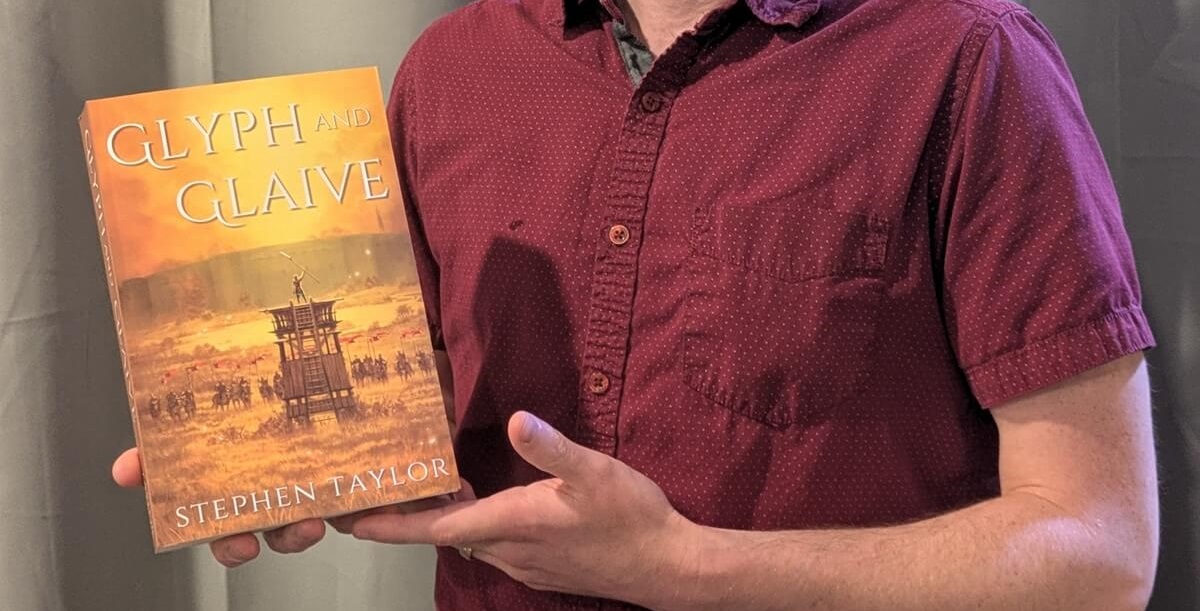
Rare’s the time that I write something here about my own books. But rare’s the time that I finish writing one. So, upon finishing work on Glyph and Glaive this year, I’d like to catalog a few thoughts on why I wrote it, what it means to me, and why I hope you’ll read it.
This will be a more or less spoiler-free look at the book, along with minimal references to Candle and Claw (the first book in The Witherclaw Trilogy). Here are a few items I’ll cover briefly below:
- What this book is about
- Where Glyph and Glaive fits into the trilogy as a whole
- Key differences between Glyph and Glaive and Candle and Claw (and some similarities)
- What I hope you’ll get from reading it
What this book is about
Glyph and Glaive is largely a war story. It takes place just over three years after the conclusion of Candle and Claw, with the Foneth-Redrem conflict in full swing. The central plot follows Jinaten ‘Tenswords’ Teserot, the senior military leader in Foneth, as she survives multiple assassination attempts and hunts for the ones responsible.
There’s the thing of the whole war getting more serious as well, not to mention new witches and Divine Order mages, more in-Foneth politicking, and multiple secret coalitions stirring up trouble near and far. But it’s mostly about Jinaten searching for answers as the clock ticks toward a major turning point in the war.
There’s a degree of continuity from the previous book. Key characters like Giovel Ullin and Varan Witherclaw appear within the first few chapters, for instance. There’s plenty of thematic continuity as well, with similar sub plots like witch hunts, glyph-building, and treachery rippling directly from the events of Candle and Claw. Glyph and Glaive is very much a sequel to book one, however. It doesn’t try to recap the events of the previous book or truly set the stage for newcomers. It’s supposed to stand on its own as a story.
Much of the plot relies on reader knowledge of the world and characters from Candle and Claw. Also, where Candle and Claw is chiefly Giovel’s story, Glyph and Glaive is mostly about Jinaten (who’s scarcely mentioned in book one). New readers will probably figure enough out to make sense of this book, but I recommend that you pick Candle and Claw up first.
Where Glyph and Glaive fits into the trilogy as a whole
I’ve done my best with this book to make sure that readers get a full story. There are plenty of threads left unresolved at the end, to be sure. But there’s no cliffhanger conclusion, and it follows Candle and Claw with enough space for it to feel like a tale of its own.
Glyph and Glaive advances several storylines from Candle and Claw, prepping for the big finale in book three. It also introduces new threads that have yet to be wrapped together at the trilogy’s end. So it’s several parts middle volume even as it stands on its own feet.
Key differences between Glyph and Glaive and Candle and Claw (and some similarities)
By virtue of having a new main character, Glyph and Glaive is a totally different story. But there are other big differences too, including:
- There’s a lot less on-page magic
- Readers will get a much closer look at the Foneth-Redrem war
- The map moves to fewer new locations, mostly sticking in familiar territory, geographically speaking
- The cast of characters is significantly larger
- The plot is tangled in more political events than Candle and Claw features
And here’s a summary of the similarities:
- Two returning viewpoint characters
- As in Candle and Claw, Glyph and Glaive features points of view from multiple sides of the main conflict (protagonists and antagonists, if that’s not too simplistic to say)
- Yulena centers heavily in the overarching story
- There’s plenty of magical trouble and wizard cop stuff
What I hope you’ll get from reading it
There’s a lot I hope this book will do for readers. At the very least, I hope it moves the larger Witherclaw Trilogy story forward. But I set out wanting book two to top book one in at least some aspects—and I think it has.
On a more granular level, I hope readers like the new characters (Jinaten, in particular). I expect a few of you will enjoy the cat-and-mouse nature of the story. And my sense, from initial reader response, is that those who appreciated the thematic journey of Candle and Claw will similarly find a lot of satisfaction in where Glyph and Glaive takes its characters.
In sum
Thanks to all the readers out there. There’s one book yet for me to write, so I hope you enjoy Glyph and Glaive in the meantime.
About the Author

Stephen Taylor is the author of The Witherclaw Trilogy as well as short fiction appearing in The Future Fire, MYTHIC Magazine, The Centropic Oracle, and other publications. His short story “Only an Ocean” won a Silver Honorable Mention in the L. Ron Hubbard Writers of the Future Contest. When he’s not writing, he’s often playing his violin or wandering in the woods.

Leave a Reply