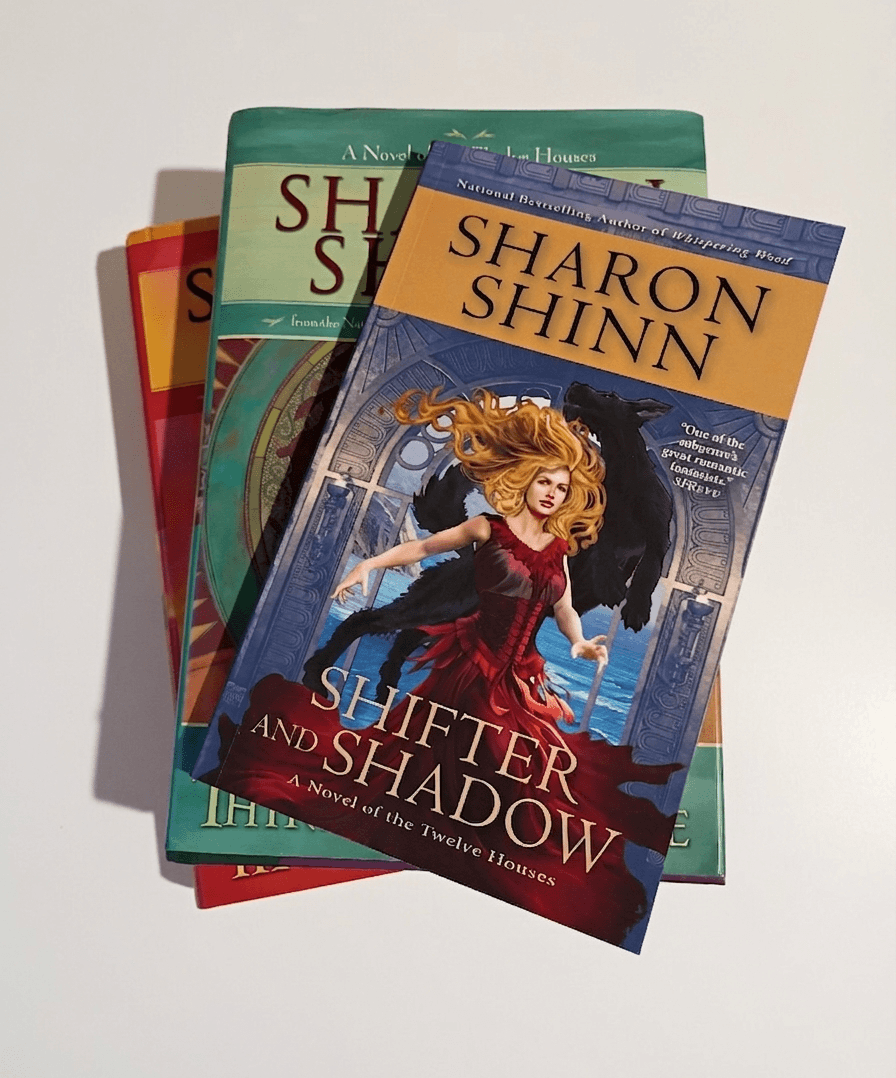
I recently revisited Sharon Shinn’s The Twelve Houses series. I’d read the first book back when it was new. It stuck with me enough that I remembered it, 20 years later, and picked it back up.
Book one was much like I remembered. The following books far exceeded my expectations.
I’m surprised Sharon Shinn isn’t better known, given how much craft and story this series have to offer. Here are five main reasons high fantasy readers should consider The Twelve Houses.
1. The Twelve Houses series brings together a great cast of characters
2. Shinn’s exploration of her magic system is fascinating
3. There’s something refreshingly accessible about The Twelve Houses
4. Each book tells a full story
5. Any book in the series could be a reader’s favorite
1. The Twelve Houses series brings together a great cast of characters
The story kicks off with a group of mystics (mages) and King’s riders (elites) embarking on a sort of reconnaissance mission across the realm. Within a chapter or two, it’s clear that this will be a motley crew sort of story. The following books hold true to that promise.
Each book in the series follows one main character, with plenty of alternating sections in others’ points of view as well. Senneth, the star of book one, comes off the page quickly. Within a few hundred pages, the rest of the leads do as well, and the character writing never looks back. Every volume brings major character growth. What really stands out, however, is the dimension their relationships bring to both subsequent character development and the overall plot.
There’s a lot to love if you grow attached to any one main character. And there’s plenty to keep coming back for if you want deep comradery like in The Lord of the Rings or other early epic fantasy. As interesting as the setting and story are, it’s the characters who carry these books most consistently.
2. Shinn’s exploration of her magic system is fascinating
At surface level, the magic in The Twelve Houses isn’t particularly groundbreaking. You’ll find shapeshifters, fire witches, magical healing, concealment, and a smattering of other skills at play. By early in book two, however, it’s clear that Shinn knows how to push her magic system to its limits, finding interesting ways to solve problems within well-trodden types of sorcery.
Brandon Sanderson, a dedicated champion for this type of magic maxing, has often remarked that it’s limitations that make magic most interesting. Shinn leans into that idea again and again (long before Sanderson was known for such a thing).
Her magic system is on the harder side of things without being difficult to grasp. Each book adds both depth and breadth, fleshing it out further. And, most interestingly, Shinn continually pulls out new ways to cleverly embrace her own rules and boundaries.
3. There’s something refreshingly accessible about The Twelve Houses
This is a series most readers can tackle without fear. Booksellers today would likely categorize it as romantasy, but it blends genres in a way that makes it a great entry point for readers new to romantasy, epic fantasy, or sword and sorcery (which is what it was often labeled as when the first few books came out).
On the romantasy side, each book features a main romantic plot/couple, complete with outright confessions of love and a few weddings. On the sword and sorcery side, the series begins literally following a sword-wielding sorcerer (who needs both her physical and magical skills at various points). And on the epic side, there’s a big long quest/journey, a broad cast of political powers, the looming threat of war, and pitched magical battles in some instances.
The Twelve Houses series is never the most romantically-focused or the most epic. But this middle ground across genre lines makes it immediately readable and quite different from standard fare.
4. Each book tells a full story
Each volume in this series has a beginning, a middle, and an end. This might not be a high bar in other genres, but for high fantasy, this sense of book-by-book completion really stands out (and it stood out even more when it was first published). If you’ve read other articles in this blog, you’ll know I place a premium on the storytelling skill it takes to write this sort of series.
The series currently sits at six volumes (five novels and one novella). As epic as the scope can become, however, the individual books are fairly short. Most are between 400 and 500 pages. Even with moderate pacing (never all that fast) throughout the series, this combination of brevity and breathing room makes it a manageable reading investment for almost anyone who likes high fantasy. You’ll never find so much plot or so many characters that you can’t keep up. And you don’t have to read 2000 pages before finding out if you’ll like anything that happens.
In all, it’s continually impressive at how clean and compact each book feels.
Which connects to the final and (IMO) most impressive characteristic of all.
5. Any book in the series could be a reader’s favorite
Not only does every book tell its own story. Each volume is powerfully distinct in terms of theme. So while the series feels consistently like itself, no two books are really about the same things.
What this does is make for a series in which any book could be a reader’s favorite (which impresses me more than anything else Shinn does here). If you want the book with the most military motion, you can pick that one (and it stands on its own quite well). Or if you want the most introspective or gentle, you have a few other options. If you want the best of all, take book one or four, or maybe three. I ended up liking book two least, but even that one hit hard and delivered on numerous promises to readers.
The point is that there’s strength balanced well across the entire series. Imagine if a series as long as The Wheel of Time achieved something like this (hint, almost no series that long ever has).
For more nerdy content like this, sign up for the monthly newsletter. It’s free to sign up, and you can unsubscribe any time.
About the Author

Stephen Taylor is the author of The Witherclaw Trilogy as well as short fiction appearing in The Future Fire, MYTHIC Magazine, The Centropic Oracle, and other publications. His short story “Only an Ocean” won a Silver Honorable Mention in the L. Ron Hubbard Writers of the Future Contest. When he’s not writing, he’s often playing his violin or wandering in the woods.

Leave a Reply