Tag: publishing

  • Four defining eras in the history of epic fantasy

    Four defining eras in the history of epic fantasy

    Epic fantasy isn’t new. It’s thousands of years old, actually. But epic fantasy as we know it now is more recent, and a few transformative eras have defined the genre with particular force.

    This article will look at some of the pivotal works and macro trends occurring in these eras.

    Like any attempt at history, this account will be zoomed out, debatable, and woefully incomplete. I’m not talking about J. R. R. Tolkien’s time at all, for instance. I’m not trying to distill everything that has happened to shape the genre. Plenty of other trends will intersect and overlap with the ones I’m looking at, furthermore. But there are patterns to be found, a few of which I’ll dig into, beginning with the first commercialized wave of epic fantasy after Tolkien’s time.

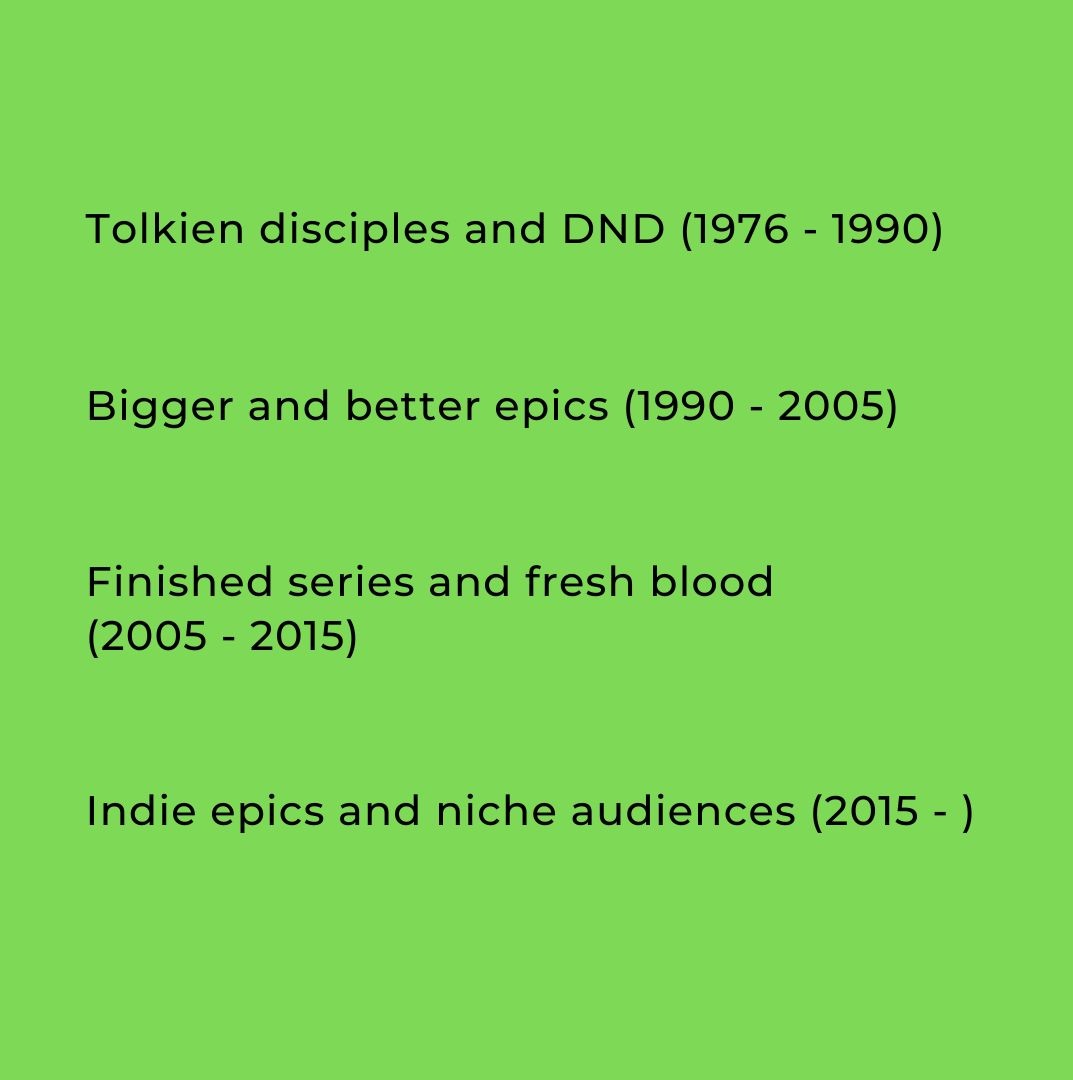
    Here are the eras I’ll analyze:

    1. Tolkien disciples and DND (1976 – 1990)
    2. Bigger and better epics (1990 – 2005)
    3. Finished series and fresh blood (2005 – 2015)
    4. Indie epics and niche audiences (2015 – present)

    1. Tolkien disciples and DND (1976 – 1990)

    It will surprise no one that the first era following Tolkien had a lot of Tolkien following. Some of this was subtle. Other examples were plain in their worship. There was, as yet, no escaping the shadow Tolkien had cast (and I’m not even trying to analyze the 20 years since The Lord of the Rings was first published).

    Fantasy as we know it didn’t yet have its own genre labels or bookshelves. But this era did a lot to set the table.

    Early genre trailblazers

    Within just a few years, Stephen Donaldson published his first trilogy in The Chronicles of Thomas Covenant. It’s a dark but well-regarded portal fantasy (one of many to come). With an overtly flawed protagonist and an unromantic worldview, Donaldson stood out immediately.

    These books made literary space for the lower, grittier elements that wouldn’t become mainstream in fantasy until the early 2000s.

    Meanwhile, Patricia McKillip completed her vastly different Riddle Master trilogy. McKillip brought a more poetic sensibility that echoed the elevated style of Tolkien without shame. She nonetheless gave readers an incredibly original setting and plot. Today’s readers likely wouldn’t realize what a Tolkien fan McKillip was when she wrote this trilogy.

    Terry Brooks’s Sword of Shannara Trilogy likewise followed Tolkien’s footsteps. Brooks leaned into the quest-like structure of The Lord of the Rings and the adventurous tone of The Hobbit. It’s fair to say that his debt also borrowed plot elements from The Lord of the Rings wholesale. But his trilogy found its own direction quickly, ushering in many followers of his own (and transporting readers into a world that would last 45 books and counting).

    Raymond Feist’s Riftwar Cycle and Anne McCaffrey’s Dragonriders of Pern were big hits in this era as well. These and other new authors showed publishers that fantasy had at least as much potential as its more well-established sibling science fiction.

    The DND contingent

    Meanwhile, there was this growing thing called Dungeons and Dragons (DND).

    Without going into all the cultural gravity of DND, it’s clear that DND had a huge impact on epic fantasy. Much of it sprang from Tolkien (like the followers above). Large readerships also came into fantasy solely through licensed DND content.

    Dragonlance (Tracy Hickman and Margaret Weis) and The Legend of Drizzt (R. A. Salvatore) were two especially popular series in this era. Readers often recommended these DND-affiliated works right alongside Gene Wolfe’s The Book of the New Sun or Ursula Le Guin’s Earthsea Cycle (though that’s not something I will do). Perhaps because of the hunger for more or perhaps because of how new the genre was, fantasy readers drew fewer lines in the sand and accepted fantasy books almost wherever they could find them.

    The long and short is that epic fantasy flourished. It found publishers, found bookstore shelf space, and found readers.

    2. Bigger and better epics

    If Era 1 was about finding readers, Era 2 was about keeping them for the long (or very long) haul. Books got fatter, and series got longer. We also saw the emergence of several more thoughtful epics (following a general pulpiness of the 80s).

    Tad Williams was one of the early greats in this era. Williams gave readers a very Tolkien-like journey in his Memory, Sorrow, and Thorn trilogy. He also offered a setting, style, and thematic journey that was much richer than the bubblegum fantasy works dominating the previous several years. Yet Williams stayed closer to Tolkien in style and tone than writers like Wolfe or Donaldson had, while still offering originality and depth (including a much lower-magic approach to epic fantasy) than many of his immediate predecessors.

    Robert Jordan and Terry Goodkind were, if anything, even more defining writers in this era. Both authors set the stage for long, connected series. To date, most epic fantasy had been contained in just a few volumes. Authors typically just wrote trilogies, modeled after the three-book publication format in which they’d encountered Tolkien. Some longer, connected series existed (McCaffrey’s Dragonriders of Pern, for instance), but it was rare to see anything beyond three or four books that continued a single storyline.

    Goodkind and Jordan doublehandedly changed this with their long, continuous series hitting shelves at the same time. And readers loved the long, newly large journey Jordan and Goodkind were offering.

    L. E. Modesitt and Kate Elliott soon followed (with their The Saga of Recluce and Crown of Stars series respectively). So did Robin Hobb with her amazingly poignant Realm of the Elderlings series. This era also introduced the soon to be phenomena called A Song of Ice and Fire and Malazan, both which followed in the longer path Jordan and Goodkind had made mainstream so quickly.

    Gone were the days when the trilogy was the ultimate form for epic fantasy. Five, seven, even fourteen books in a single story was an idea readers liked, thanks to a few daring authors and some bold publishers backing them. And it wasn’t only about length either. There was new depth and breadth to so many series coming out.

    3. Finished series and fresh blood

    The challenge with big series is that it takes years—even lifetimes—to complete them. A distinct new era arrived before Jordan or Goodkind finished their landmark series. Also, the publishing world was getting tired of waiting.

    If you scour the internet, you’ll find many a forum discussion and blog article in this era talking about epic fantasy being out of date. Urban was all the rage. Harry Dresden grew in popularity and Twilight permeated mixed groups of readers. Publishers, in particular, kept saying they wanted something different from old, second-world epics.

    The profile of emerging talent and readerships paints a somewhat different picture.

    Big changes rolling across the genre

    Between 2005 and 2015, several major things happened to cement epic fantasy’s lasting place.

    • Endings: Readers did indeed reach the final volumes of Goodkind’s Sword of Truth series and Jordan’s The Wheel of Time. These were both huge milestones, especially for doorstopper epic series.
    • Beginnings: The genre saw a massive influx of new talent. Patrick Rothfuss, Joe Abercrombie, Scott Lynch, Daniel Abraham, Elizabeth Bear, Brandon Sanderson and Naomi Novik all hit the scene within just two years of each other. N. K. Jemisin, Peter V. Brett and others debuted only a few years after that. The masters of the previous era (many who were completing their series now) were replaced at an incredible clip.
    • Pausings: We also had a few high profile delays in epic fantasy publishing during this time. We just didn’t know how big the delays would be for writers ranging from J. V. Jones to Scott Lynch to George R. R. Martin. But some of the most popular series out there got delayed. And delayed again.

    While new talent swept in to take the spotlight from more recent writers, authors from earlier eras also made new splashes. Terry Brooks released his Genesis of Shannara trilogy, one of his strongest out of all his connected works and an early marker of the direction his series would go to completion. Tad Williams came back strong to epic fantasy with his Shadowmarch series. Sean Russell completed his Swan’s War trilogy, which remains his most epic fantasy work to date (and a personal favorite of mine).

    Grimdark also saw a rapid rise during this era. A few authors had dipped into this subgenre already (Paul Kearney, for instance). But Richard K. Morgan and Mark Lawrence cemented the subgenre, largely following Abercrombie’s popularizing influence.

    More new works hit the shelves

    Oh, and now that a few big series were done, we started to get new ones. There were modest-sized epics like Brent Weeks’s Lightbringer series (perhaps a million words in all). And then, even before finishing Jordan’s The Wheel of Time, Sanderson began publishing his own massive epic, The Stormlight Archive. Furthermore, Tad Williams came back with more Osten Ard books, and Robin Hobb kept extending the breadth of her Realm of the Elderlings.

    This period brought huge momentum for established writers while introducing a host of new voices. No matter what publishers claimed early on, it was a momentous time to be reading epic fantasy.

    4. Indie epics and niche audiences (2015 – present)

    With several decades of fantasy works available now, readers started getting pickier. Gone were the days when I’d jump from Icewind Dale (R. A. Salvatore) to Gene Wolfe’s Shadow and Claw (and yes, I really did read these back to back). With so many choices, readers could find what they really wanted.

    There was this thing called social media, too. And smartphones making book recommendations available all day, every day. The big book recommendation forums folded into subreddits, and bloggers started becoming influencers. As a result, micro communities and niche audiences became all the norm. It was just a lot easier to find books that truly fit the vibe you wanted.

    Enter indie fantasy.

    Indie epic fantasy at a glance

    A few important indie figures predated this era. Michael J. Sullivan, for instance, started selling well a few years earlier. But the advent of new tools to find books made it possible for hundreds of indie fantasy authors to carve out their own places in the epic fantasy landscape. Several quickly aligned with traditional publishers (David Dalglish, Evan Winter, Anthony Ryan, and Sullivan mentioned above), though they often kept indie works moving as well. Others stuck purely to indie avenues, often finding commercial success through small but loyal audiences and faster times to publish.

    Indie publishing of course changed every aspect of book publishing. But for epic fantasy—which had grown into long series, protracted publishing timeframes, and even delayed completion—indie publishing was almost as game-changing as the mega-series model Goodkind and Jordan had introduced in the 90s. If you want more quest-like fantasy reminiscent of early Salvatore or Brooks, you can find it. If you want something punchier or darker, you can find that too. Short, long, high or low magic, indie fantasy has flooded readers’ to-be-read lists with relevant titles, often super-focused on specific reader interests.

    This has somewhat diluted the author-as-brand model of loyalty that dominated book publishing in all previous eras. But it has also made epic fantasy (all fantasy) more generally varied and inclusive.

    What’s next for epic fantasy?

    Few authors remain actively writing from the first era I’ve analyzed for this article. Brooks has retired. Salvatore has moved on to writing books about Breezy Do’Urden (props for that, Drizzt probably has enough books by now). Writers from the next era have mostly retired as well.

    It’s clear that a lot of readers are still watching Jemisin, Abercrombie, Sanderson and others from era 3. But it has been the better part of two decades since we’ve had a single debut with as much gravity as some of the 90s and 00s others managed. There’s too much publishing noise, too much volume for it to happen the same way (yet).

    Oh, and there’s AI. So here are a few things we can expect to see happen in the next era of epic fantasy.

    • Continual glut of content, including numerous AI-written novels that come and go rapidly
    • Steeper segmentation of readership as micro-communities hover around their influencer voices and subgenres of choice
    • Completion of the largest works outstanding from the last era (or two eras, hopefully)
    • A general decline in publisher interest in epic fantasy until a few more major new authors hit the scene (little wonder that romantasy is the dominant player right now)
    • Plenty of great authors still writing great epic fantasy, regardless of publisher preference

    There hasn’t truly been a bad time to be an epic fantasy reader in 50 years.

    I don’t think there ever will be.


    For more nerdy content like this, sign up for the monthly newsletter. It’s free to sign up, and you can unsubscribe any time.

    Sign me up

    * indicates required

    Intuit Mailchimp

    About the Author

    Headshot of epic fantasy author Stephen Taylor.

    Stephen Taylor is the author of The Witherclaw Trilogy as well as short fiction appearing in The Future Fire, MYTHIC Magazine, The Centropic Oracle, and other publications. His short story “Only an Ocean” won a Silver Honorable Mention in the L. Ron Hubbard Writers of the Future Contest. When he’s not writing, he’s often playing his violin or wandering in the woods.

  • The reader journey: How people choose what books to buy and read

    The reader journey: How people choose what books to buy and read

    I’ve long been fascinated with the reader journey. Specifically with how readers make their purchasing and reading decisions. A few key reasons:

    1. I like to read, and I’m often puzzled by how I ended up choosing this book or that author.
    2. I actually like marketing, so this whole decision-making process interests me.
    3. There’s a dearth of data on the reader journey.

    I’ve shared a few resources for finding the right books, specifically for epic fantasy readers, but in this article I’m going to dig deeper into the wider reader journey, based on what data I could actually get my hands on (most of which is helpful but woefully dated).

    Here goes.

    Who’s reading books, and who’s not?

    The majority of Americans still read books—old fashioned, printed on paper books.

    In 2022 the Pew Research Center reported that 75% of adults said they’d read at least one book in the previous year (though some people probably lie about reading because they want to sound cool). This was a significant increase from previous years, where numbers were closer to 64%. Furthermore, most readers favored print formats, with only 9% of U.S. adults restricting their book consumption to digital formats (and a large number consuming in both print and digital).

    The 2022 US Book Reading Statistics survey squared with Pew’s findings that print books still dominate the market, showing a commanding 20% lead in print product share over ebooks. As you’d expect, age and other demographics can also tell us a lot more about who’s reading and which formats are getting traction. For instance, this survey indicated that adults aged 65 or higher were most likely to read overall and most likely to prefer print books over digital, and that consumers identifying as male were less likely to read than were those identifying as female.

    A 2021 Gallup poll, however, indicates that readers are reading fewer books overall (regardless of how many Americans are reading). Likewise, WordsRated’s most recent look at daily reading habits indicates that readers are spending 16-17% less time reading daily than they were a decade ago (although per day reading time has been climbing up again since 2018).

    Demographics included or aside, reader habits accounted for, there’s a clear demand for books, especially in print formats.

    What’s the journey for readers to choose what books to buy—or read?

    Most active readers have no shortage of titles on their to-be-read lists. Data from Kobo (old data, it’s worth noting) indicates that up to 50% of online fiction sales originate with book-specific searches—meaning that readers already knew which book they meant to look for and buy. On one hand this simplifies the reader journey, because readers don’t struggle to find something they want to read. On the other hand, it makes the reading journey incredibly complex, because the choice to read one book means choosing not to read another for the time being.

    This stage of the journey is where market data falls shortest—and is most needed.

    Author Gigi Griffis surveyed 355 avid readers in 2017 to try answering the big question of how readers choose what books to buy. Griffis’s data is very telling, though it’s worth noting that we need a lot more surveys like this one because:

    • This study primarily focused on the very active, serial readers (which is just one segment of another segment of all readers).
    • Survey participants are nearly all fiction readers primarily (and adult nonfiction drives more sales revenue in the U.S. than any type of fiction does), limiting applicability to the wider reading conversation.
    • The data is nearly six years old now, with lots of changes in the book landscape since then.
    • And last but not least, despite this being a terrific source of insights, it’s still working from a very small sample.

    All reservations aside, here are some telling findings from Griffis’s survey:

    The biggest reason readers buy books is because they know and love the author

    There’s clear consensus on the forces influencing book purchases, and the top two survey responses support some old anecdotal assumptions about the reader journey:

    • 82% of readers bought a book because they already knew they loved the author.
    • 76% bought because of a friend’s recommendation.
    • 48% went for a new book because of a giveaway or sale.
    • 47% attributed their purchase to amazing cover art.
    • 44% took author recommendations to get a new book.
    • 39% made a purchase based on book blog recommendations.
    • 39% also bought based on placement in a physical store.
    • 36% picked up a book because of recommendation in some sort of non-blog publication.
    • A number of readers purchased based on social media experiences as well:
      • 35% found new books to buy via Facebook.
      • 28% discovered and purchased new books thanks to Twitter (now X, I guess? Who even knows?).
      • 12% bought after Instagram exposure.
    • 11% found and purchased new books thanks to library recommendations.

    There’s a fairly even split across common forces in the buying process

    Griffis also asked avid readers to identify the reasons that influence purchasing decisions most commonly—the repeated, persistent influences behind the buying process. Unsurprisingly, the top reason readers buy is because they already know they love an author’s work. Reason number two (barely below number one) is because of a friend’s recommendation. These two combined accounted for 46% of book purchasing decisions among Griffis’s respondents.

    The buying process is similar across readers as well

    The three most common steps Griffis’s avid readers took before purchasing were:

    1. Reading the back cover (82%)
    2. Reading book reviews (56%)
    3. Reading sample pages from the book (41%)

    It’s also worth noting that 13% of these readers said they purchased books without doing any of the above. This shouldn’t be terribly surprising based on how big a factor existing fandom is for readers, but it makes an interesting case for some other marketing elements like cover art, bookstore placement, overall author brand, etc.

    Book reviews play a huge role in getting new readers to buy

    Another really valuable element to Griffis’s survey is an exploration into where readers get their book reviews—and what they glean from them.

    As noted above, 56% of avid readers check the reviews before they buy a new book. Here’s Griffis’s breakdown of where this happens:

    • 76% of readers consume book reviews on Amazon.
    • 64% of readers read Goodreads reviews.
    • 25% of readers check reviews in newspapers, magazines, and other publications.
    • 24% of readers read reviews on book blogs and similar resources.
    • Just 6% of readers sample Barnes and Noble reviews.

    Furthermore, Griffis’s survey unearthed some really interesting nuggets as to how reviews influence the purchasing journey for readers. While the survey doesn’t show what convinced readers, it explores a big batch of reasons avid readers would refuse to buy a book:

    • 56% of readers would skip out on a purchase if reviews mentioned the book having typos or grammar fails.
    • 25% of readers were put off by reviews mentioning a slow middle.
    • 24% of readers would avoid purchasing a book if the reviews said the plot was unbelievable.
    • 21% of readers would skip a book if reviews showed distaste for the book’s ending.
    • 20% of readers would forgo a book purchase if reviews said the main character was unlikable.

    Griffis has several other interesting findings as well, so her survey is well worth looking at, aged or not.

    What makes readers read the books they purchase?

    Selling the book is only half the battle. Actually, it might be even less than half, based on some of the clearest post-purchase reader data.

    Jellybooks, a tool and reader service used to analyze book reading habits, has reported less than 40% completion rates for most books that readers purchase. They’re not the only entity looking closely at this. Kobo—which has even more robust and accurate ways to measure reader behaviors—has consistently found that the best-selling books are not the most read books, and certainly not the books readers are most likely to read to the end.

    While it should in no way come as a surprise that many readers opt not to finish every book they buy, there’s very little clear data on which journeys led to incomplete readings, which reader personas are most likely to abandon a book, etc. The only truly clear insights come from Kobo’s decade-old findings that readers were more likely to complete books in the romance, thriller, and mystery genres—which will come as no surprise to anyone familiar with reader loyalty in these genres.

    A clear implication, however, is that readers won’t become long-term, serial purchasers in cases where they don’t finish the books. Since Griffis found that author loyalty is the biggest influencer in avid readers’ purchasing habits, it stands to reason that readers need to build that loyalty by reading the books and not just by purchasing.

    Where does all this leave readers? And writers? And publishers?

    No matter what you make of these scattered findings, the publishing market is due for some more data. It is much easier now to track reading behaviors, given the omnipresence of digital formats, but Jellybooks customers, Kobo authors, and big New York publishing houses alike are often investing most heavily in books that make neither a commercial nor a literary impact.

    There’s always guesswork where taste is concerned, but there should be data on the reader journey too.


    For more nerdy content like this, sign up for the monthly newsletter. It’s free to sign up, and you can unsubscribe any time.

    Sign me up

    * indicates required

    Intuit Mailchimp


    About the Author

    Headshot of Stephen Taylor

    Stephen Taylor is the author of The Witherclaw Trilogy as well as short fiction appearing in The Future Fire, MYTHIC Magazine, The Centropic Oracle, and other publications. His short story “Only an Ocean” won a Silver Honorable Mention in the L. Ron Hubbard Writers of the Future Contest. When he’s not writing, he’s often playing his violin or wandering in the woods.

  • There are many paths to tread (Part II): 6 different publishing paths for indie fantasy authors

    There are many paths to tread (Part II): 6 different publishing paths for indie fantasy authors

    What paths lead from an idea to getting that idea in front of an audience of appreciative readers? In last month’s blog post, I explored this topic with five authors who partnered with literary agents and traditional publishers. This month, I’m looking at the publishing paths of six indie fantasy authors.

    What publishing paths to indie fantasy authors take to launch and sell their books?

    The path is different here since indies can publish pretty much immediately. So, I’m showing the publishing paths of indie authors who have actually built meaningful audiences and established themselves as writers to watch.

    As with last month’s article, I want to emphasize that I see each of the authors as exceptional, not the default. I don’t expect anyone else to reap the same results they have simply by following the same steps. However, the evidence is that many authors are seeing similar success with the same kinds of steps. So there’s value to considering these publishing paths, even if those paths aren’t golden tickets to stardom.

    On with the examples.

    M. L. Wang: As indie as Indiana Jones

    Book cover for M. L. Wang's fantasy novel The Sword of Kaigen.

    M. L. Wang’s best-known work is The Sword of Kaigen, which she published in 2019. The Sword of Kaigen is a highly unconventional novel. It’s unique in terms of structure, pacing, and the organization of viewpoint characters. It’s difficult to describe or market in genre-wide terms. But reviewers and readers (including me) love it.

    Wang self published two books before The Sword of Kaigen, but neither of these took off in the same way this one did. Word really got out about Wang’s writing when she entered and won Mark Lawrence’s 2019 Self-Published Fantasy Blog-Off (SPFBO) contest. This win alone secured numerous reviews and lots of visibility for the novel even before new sales started coming in.

    Her journey to making the book available might look simple. Wang’s success with The Sword of Kaigen is a huge example of the distinctive strengths of independent publishing, however: Giving space for books that don’t fit cookie cutter formats preferred by large publishing houses. This is a novel with a singular shape. It’s hard to imagine where most bookstores would shelf the book or which audience a large press would target. Most publishing houses would not have taken a chance on The Sword of Kaigen in the first place.

    But Wang did, and it’s paying off for her.

    What I see as the takeaways: Like Rothfuss and Muir (see last month’s post), Wang benefited from the visibility of a well-known award. Few awards are likely to influence serious sales boosts like her book has experienced, however. In the end, it’s the strength of her writing that makes this book memorable and relatable. As with traditional publishing paths, writing a quality book is the best thing an indie author can do to create their own space.

    Michael R. Miller: Narrowing the audience

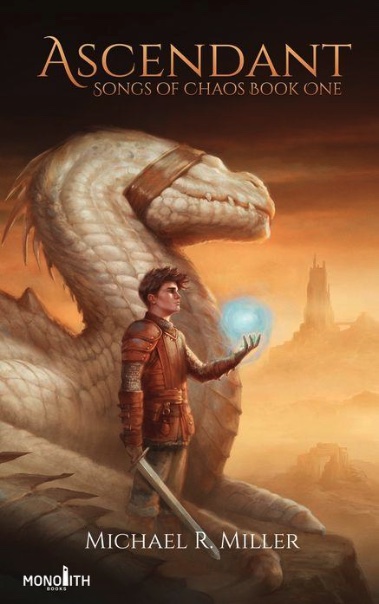
    Book cover for Michael R. Miller's epic fantasy novel Ascendant.

    Michael R. Miller has found considerable success with his first series, The Dragon’s Blade Trilogy, which has topped Amazon’s bestseller lists for epic fantasy, sword and sorcery, and YA fantasy among other categories. As if that isn’t impressive enough, his next series–currently in the works–has pushed him forward to an even bigger and more loyal audience.

    Here’s the pitch for Miller’s Songs of Chaos series: “A servant boy defies society to save a blind dragon from death and rises to become a dragonrider!” If it sounds familiar, it’s probably because it is. It’s strikingly similar to a) Christopher Paolini’s Inheritance Cycle, and b) book three of Anne McCaffrey’s Dragonriders of Pern trilogy. Oh, and there’s also a very clear progression fantasy play at work in this series, to add to the mix of clear influence.

    So, with such obvious and well-beloved influences, how did Miller go about marketing his new series? He does it obviously. Here’s some copy from the first book’s Amazon page: “…combining the best of Eragon and Pern with the hard magic of Brandon Sanderson and Will Wight.”

    Miller isn’t actually making an outlandish claim here. That’s what the books read like: Cradle + Eragon + Pern.

    What I see as the takeaways: Miller’s path to indie publishing is almost the opposite of Wang’s above. Miller entered the scene with some traditional publishing experience behind him. Then he found a space with hungry audiences and targeted those audiences narrowly, repeatedly, specifically. Whether Miller wrote his books intending to reach this existing audience or not, I don’t know, but his precision targeting (which really helps his landscape of advertisements) has helped him find a large and loyal audience.

    Daniel Greene: Writing from a strong platform

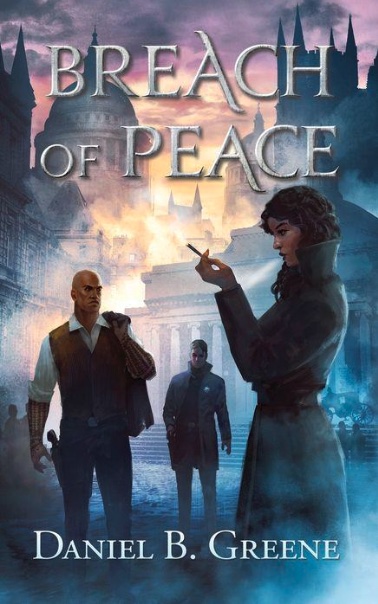
    Book cover for Daniel Greene's dark fantasy novella A Breach of Peace.

    Daniel Greene, aka your disheveled goblin host, is most well known as a YouTuber. He entered indie publishing last year with his debut novella, Breach of Peace, following this up with a short novel several months ago.

    Greene reported 30,000 sales of Breach of Peace within the first week of its publication. Based on its sales rankings since then, it has likely sold over 250,000 copies now, just 14 months since publication.

    For context, Brandon Sanderson just reported that he too reached 250,000 sales in the first year for one of his more widely anticipated releases. This figure isn’t terribly surprising, since Sanderson is a massive name in the genre, with 16 years of consistent bestsellerdom behind him. So, for Greene to come anywhere close to that figure is an astonishing win.

    In the end, though, Greene moved books in a really similar way to how Sanderson does it now: He’s a community player with a platform he has built carefully over time (over 300K YouTube followers when Breach of Peace came out, for instance, and now over 400K). He did a lot of leg work beforehand, not just to get the word out but in a way that other influential figures like reviewers and YouTubers would also get the word out.

    What I see as the takeaways: Plenty of authors publish and sell books without having an audience in place before the book is available. I think it’s fair to say this is the case for most people who write fiction. But in the end, having an audience from the date of publication definitely helps. Note that science fiction writer John Scalzi took a similar path with his very successful blog (through which he published his first novel).

    Evan Winter: Moving from indie to trad

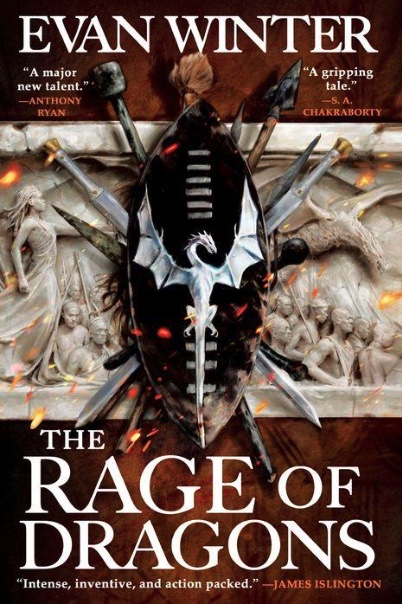
    Book cover for Evan Winter's epic fantasy novel The Rage of Dragons.

    Evan Winter made quite a splash with the publication of The Rage of Dragons. Fans pretty much love the following book as much as the first.

    Winter published his first novel through Amazon’s Kindle Direct Publishing (KDP). In his own words, he didn’t expect his writing to be more than a hobby. He found almost overnight success after sharing information about his book on r/Fantasy, a community he’d been a part of for some years by then. His debut quickly climbed to the top 250 books selling on Amazon that day. Soon thereafter, an editor from Orbit contacted Winter with interest in a book deal.

    After an initial phone conversation, Winter relates that “the editor got back in touch to say that Orbit was going to make an offer and that I should get an agent.” Shortly thereafter, Winter had both an agent and a deal to publish not one but four books. More importantly, perhaps, people just keep reading and loving what Winter writes.

    What I see as the takeaways: Like Greene, Winter was part of the community. When he wanted to find readers, he knew where they were and knew how to communicate with them. Also, when you write something people want to read, publishers tend to take notice.

    For additional examples of the indie to traditional path, take a look at:

    Michael J. Sullivan: Building a backlist

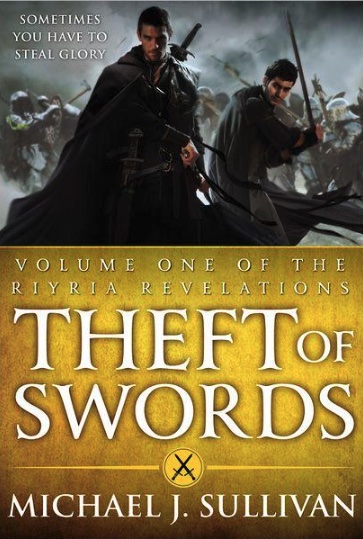
    Book cover for Michael J. Sullivan's epic fantasy novel Theft of Swords.

    Michael J. Sullivan is a particularly interesting case as a hybrid author. Like many others, he completed numerous manuscripts, sent them to agents and editors, and collected a list of rejections before ever publishing anything. He also worked with a small press which couldn’t deliver on the printing and distribution volumes Sullivan’s work evidently merited.

    Eventually, Sullivan regained publishing rights for The Riyria Revelations and began publishing them himself. His sales numbers grew as he expanded the series. He eventually began selling about 1000 books per month. He also got a six-figure book deal–his runway into traditional publishing with a big New York press. Before this deal was ever made public, Sullivan’s sales leaped up to 10-12K copies per month, earning him upward of $35,000 for each of those months.

    Perhaps because of this success, Sullivan has retained a close connection to the indie world, even after releasing quite a few volumes through traditional publishers. Sullivan has run multiple successful kickstarters to fund new books, for instance. He has worked closely with Grim Oak Press—a small publisher—as well.

    What I see as the takeaways: Sullivan is a great example of building an audience via multiple volumes. The majority of indie authors establish loyal audiences over time by releasing several, even many books. These writers (see Lindsay Buroker as another example) don’t often see large sales numbers until they have a backlist of books to their names, just as Sullivan did.

    One final example: Christopher Paolini

    Book cover for Christopher Paolini's high fantasy novel Eragon.

    Christopher Paolini’s indie publishing path might be even more exceptional than the rest I’ve mentioned. He was only 15 when, with the help of his family, he published Eragon. That said, it’s also one of the more illustrative examples out there.

    Paolini had the benefit of some in-family expertise. His family operated a small press that had previously published a few other books. He also emerged at a time of voracious interest in fantasy for middle grade and young adult audiences. This reader interest undoubtedly helped secure his eventual book deal with Knopf and his 121 consecutive weeks on The New York Times Best Seller list.

    What was not exceptional for Paolini was that he first grew his audience by going out and sharing his work. He attended over 135 in-person events to promote his first novel, making as many as 70 stops in a single year.

    What I see as the takeaways: People buy books that are recommended to them. This is true even when the author is the one going out to make the recommendation.


    Sign up for the newsletter to get more nerdy content like this in your inbox.

    Sign me up

    * indicates required

    Intuit Mailchimp


    About the Author

    Headshot of epic fantasy author Stephen Taylor.

    Stephen Taylor is the author of The Witherclaw Trilogy as well as short fiction appearing in The Future Fire, MYTHIC Magazine, The Centropic Oracle, and other publications. His short story “Only an Ocean” won a Silver Honorable Mention in the L. Ron Hubbard Writers of the Future Contest. When he’s not writing, he’s often playing his violin or wandering in the woods.

  • There are many paths to tread (Part I): 5 unique publishing journeys of fantasy authors

    There are many paths to tread (Part I): 5 unique publishing journeys of fantasy authors

    Though Peregrin Took usually gets the cinematic credit, it was Bilbo Baggins who penned the line “there are many paths to tread.”

    Peregrin Took singing an adapted version of Bilbo Baggins's "A Walking Song" in the film The Return of the King.

    In this month’s post, I’ll use Bilbo’s “A Walking Song” to dig into the many varied paths fantasy authors traverse from coming up with a story idea to getting that idea published.

    As a genre, fantasy has an interesting relationship with the world of publishing. Take the very circuitous journey of The Lord of the Rings in the USA as an example. It’s no surprise that authors face all sorts of difficulties when trying to break in, to get a book deal, to find an audience, etc. Likewise, I find a sort of solace in the fact that so many top tier authors take their own unique publishing journeys.

    So how do fantasy author get their books published?

    First note before digging in: I’ve limited my list to authors who published their first novel since the turn of the century. This is mostly to account for the internet as part of the road to publication. Also, most of the authors I’m talking about have large readerships and have sold quite a few books. I believe every author I’ll mention is exceptional. None of their paths to publishing should be viewed as straightforward, direct, or any kind of easy. Yet I find a lot of insight in how these different writers undertaken their professional publishing journeys.

    Second note: I’ve provided some visuals to help make these publishing journeys more digestible. The caveat is that these images are necessarily (and purposefully) reductive.

    Final note: In this month’s post I’m only looking at examples of authors entering the world of traditional publishing. Next month’s post will dig deep into author examples across indie publishing.

    N. K. Jemisin: Step-by-step among publishing journeys

    It’s hard to find a living writer more lauded than N. K. Jemisin–inside or outside speculative fiction. Some of her more recent accolades include a MacArthur Fellows “Genius Grant” in 2020 and winning the Hugo Award for best novel three times in a row (which has never happened before) for all three books in her Broken Earth trilogy.

    Book cover for N. K. Jemisin's debut fantasy novel, The Hundred Thousand Kingdoms.

    Jemisin found acclaim early on in her publishing career, but her path to get there was fairly incremental.

    After collecting rejections for two finished novels, Jemisin went to Viable Paradise, an intensive, one-week writing workshop focused on speculative fiction. Her experience there led her to start writing short stories. Those stories then found homes in semipro and professional publications such as Ideomancer, Escape Pod, Strange Horizons, Apex Magazine, and Clarkesworld.

    Meanwhile, Jemisin wrote a new, big idea novel. With some short stories to her name and a standout new manuscript, she secured a representation deal with her literary agent, Lucienne Diver. Diver shared the novel with a number of editors, but no one bit yet. It was only after Jemisin’s short fiction received both Hugo and Nebula nominations and she wrote another novel (which sold at auction in a six-figure deal) that her previous manuscript was published as well.

    This was still before she even got to her Broken Earth trilogy. That work really propelled her into wider recognition across epic fantasy, science fiction, and other genres.

    Steps N. K. Jemisin took to becoming a published fantasy author.

    What I see as the takeaways: Jemisin’s success was anything but overnight. She kept writing new stuff and seeking new ways to improve. I think it’s fair to say–from each of her works I’ve read–that she never stopped producing her own kind of stories, even when editors told her they weren’t marketable. Her path to publishing success built that uniquely Jemisin momentum up over a long time.

    Patrick Rothfuss: Taking a few big steps in the publishing journey

    Patrick Rothfuss hit the scene hard in 2007 with the debut of his first novel, The Name of the Wind. It was perhaps the most hyped fantasy debut I’ve ever observed, with a big auction for the publishing rights, rapid chatter throughout the ecosystem of blogs and forums (yep, forums were a big thing back then), and advance reviews and sky-high praise from dozens of authors I love.

    Book cover for Patrick Rothfuss's debut fantasy novel, The Name of the Wind.

    This early buzz was even more remarkable given that Scott Lynch, Joe Abercrombie, Brandon Sanderson and several other big names had just debuted as well, with additional books already hitting shelves in 2007.

    Rothfuss’s is one of the more linear publishing journeys out there. For starters, Rothfuss took longer to write his first novel than most writers do, working on the same story from 1994 until book one of the tale was finally published in 2007. Rothfuss’s main step toward getting an agent–who subsequently brokered his book deal–was submitting to the L. Ron Hubbard Writers of the Future contest. His submission, an excerpt from his then unfinished second novel, won him a quarterly prize in the contest and led him to meeting Tim Powers and then his agent, Matt Bialer.

    With Bialer’s help, Rothfuss continued polishing his manuscript a few more years and then secured a three-book contract with Daw.

    [image]

    Steps Patrick Rothfuss took to becoming a published fantasy author.

    It’s hard to overstate, however, that while this path doesn’t have many steps or tales of rejection letters, these were extraordinary steps. First off, Bialer was already one of the most recognized and connected agents in epic fantasy. Secondly, it still took several years to move from agent to book deal to published manuscript, and Rothfuss reports working through extensive phases of editing, writing new story threads, and revision at this time. Third, winning a quarterly prize in the Writers of the Future contest was no easy feat either. Last of all, Rothfuss’s debut novel was exceptionally strong. His journey paid off for readers, not just for himself, with a book that was well worth all the hype and excitement.

    The Name of the Wind and Rothfuss’s second book combined have sold well over 10 million copies worldwide.

    What I see as the takeaways: Although quality doesn’t always win out, it definitely can. Rothfuss’s success isn’t based on writing 100 solid novels. It’s based on writing and polishing and rewriting one really good book that got agents, editors, other writers, and readers really excited. This path looks to me like a particularly tough one to mirror, but it definitely worked for Rothfuss.

    Tamsyn Muir: Some of both

    Although Tamsyn Muir has been publishing SFF since 2010, she began garnering much more notice with the release of her genre-busting first novel Gideon the Ninth. The book not only captured the attention of many readers and writers but earned World Fantasy, Hugo, and Nebula nominations as well as the 2020 Locus Award for Best First Novel.

    Book cover for Tamsyn Muir's debut fantasy novel, Gideon the Ninth.

    Perhaps it goes without saying, but very few books earn nominations for SFF’s four biggest award programs, let alone wins in any of them.

    Like Jemisin, Muir took both the route of professional workshops (Clarion, in her case) and short fiction. She placed stories and novelettes in magazines such as Lightspeed, Nightmare, Clarkesworld, and the Magazine of Fantasy & Science Fiction. Her first publication, “The House That Made the Sixteen Loops of Time” was a story she wrote during her final week at Clarion.

    When Muir’s fourth short story came out, it collected nominations for the Shirley Jackson, World Fantasy and Nebula awards, among others. Subsequently, an agent approached her with interest in representing her work. Muir didn’t end up working with that first agent, but she did instead get an offer of representation from Jennifer Jackson, long-time agent for a few big names like Jim Butcher (see below), Elizabeth Bear, and Martha Wells.

    Steps Tamsyn Muir took to becoming a published author.

    What I see as the takeaways: Professional workshops can really move the needle for speculative fiction writers. Short fiction often opens doors toward bigger publishing journeys. And winning some major genre awards never hurts either. Also, once legitimate agents start approaching you, you’re probably more than ready to successfully approach such agents in return.

    Jim Butcher: Retracing some steps on the path to publication

    Jim Butcher’s audience has grown steadily for two decades. Most of this has come with the expansion of his urban fantasy / mystery series The Dresden Files. He now has 17 out of 22 planned volumes in print with the same publisher (plus two other series). It all stems from one initial book deal.

    Book cover for Jim Butcher's debut fantasy novel, Storm Front.

    Butcher’s own account tells the story well. He queried numerous agents and editors for a few years without success. Over time he identified a specific agent he thought would be a fit, based on what else she represented. Butcher queried her. She responded with a no.

    Not to be deterred, Butcher found out what conventions and conferences this agent would be attending. He armed himself with relevant conversation-starters, and went to meet her in person. If you’ve heard Butcher speak before, you’ll know he has a lot of charisma (probably no surprise if you’ve read The Dresden Files either). So, with an in-person chance to make an impression, Butcher got himself invited to lunch. He received an offer of representation–that same day. Six months later, he had a book deal.

    Steps Jim Butcher took to becoming a published fantasy author.

    What I see as the takeaways: Butcher did his research and stuck to his strengths. He didn’t throw in the towel when he faced rejection. He kept writing along the way as well. Consequently, he had more than just one book ready when he finally had a deal. In Butcher’s own words, “Here’s the secret of how to get published: keep going.”

    Brandon Sanderson: Betting big on replicable publishing journeys

    Brandon Sanderson is probably most well known for his Mistborn novels and completing The Wheel of Time after Robert Jordan’s death. His reputation extends far beyond selling books, though he has at least 21 million sales to his name since last year.

    Book cover for Brandon Sanderson's debut fantasy novel, Elantris

    Despite his astronomical success, Sanderson’s path to publishing was exceptionally practical. He wrote novels, queried editors and agents, stacked up rejections, queried new projects, collected more rejections, and then started attending professional events to try meeting the right agents and editors in person.

    Eventually, he met his future editor Moshe Feder in person. Feder agreed to look at a manuscript, but took 18 months to do it. Sanderson had given up on that particular submission when Feder called him up with an offer to buy the book.

    With a book deal at his door, but not finalized, Sanderson then went back to his agent search. He contacted Joshua Bilmes, whom he’d also met in person and queried multiple times. Bilmes agreed to represent Sanderson and helped secure an even better book deal with Feder / Tor Books.

    You could say there are other big steps in here as well. Sanderson’s involvement in The Wheel of Time didn’t hurt. Nor did running the biggest Kickstarter campaign ever. But he built a strong name for himself before doing either of these things.

    Steps Brandon Sanderson took to becoming a published fantasy author.

    What I see as the takeaways: No one should expect to build a reading community like Sanderson has. The steps he took to get in the door are pragmatic and repeatable, however. He wrote a lot. He queried. And he networked at the right events, looking for editors and agents who were very likely to fit his work. Like Jemisin, he wasn’t an overnight success. He put in the hard work, got his foot in the door, and grew from there.

    Other paths to publication

    Stay tuned next month for another look at publishing journeys. That post will analyze how several indie and hybrid fantasy authors have navigated their own publishing paths.


    Sign up for the newsletter to get more nerdy content like this in your inbox.

    Sign me up

    * indicates required

    Intuit Mailchimp


    About the Author

    Headshot of epic fantasy author Stephen Taylor.

    Stephen Taylor is the author of The Witherclaw Trilogy as well as short fiction appearing in The Future Fire, MYTHIC Magazine, The Centropic Oracle, and other publications. His short story “Only an Ocean” won a Silver Honorable Mention in the L. Ron Hubbard Writers of the Future Contest. When he’s not writing, he’s often playing his violin or wandering in the woods.
css.php