Epic fantasy isn’t new. It’s thousands of years old, actually. But epic fantasy as we know it now is more recent, and a few transformative eras have defined the genre with particular force.
This article will look at some of the pivotal works and macro trends occurring in these eras.
Like any attempt at history, this account will be zoomed out, debatable, and woefully incomplete. I’m not talking about J. R. R. Tolkien’s time at all, for instance. I’m not trying to distill everything that has happened to shape the genre. Plenty of other trends will intersect and overlap with the ones I’m looking at, furthermore. But there are patterns to be found, a few of which I’ll dig into, beginning with the first commercialized wave of epic fantasy after Tolkien’s time.
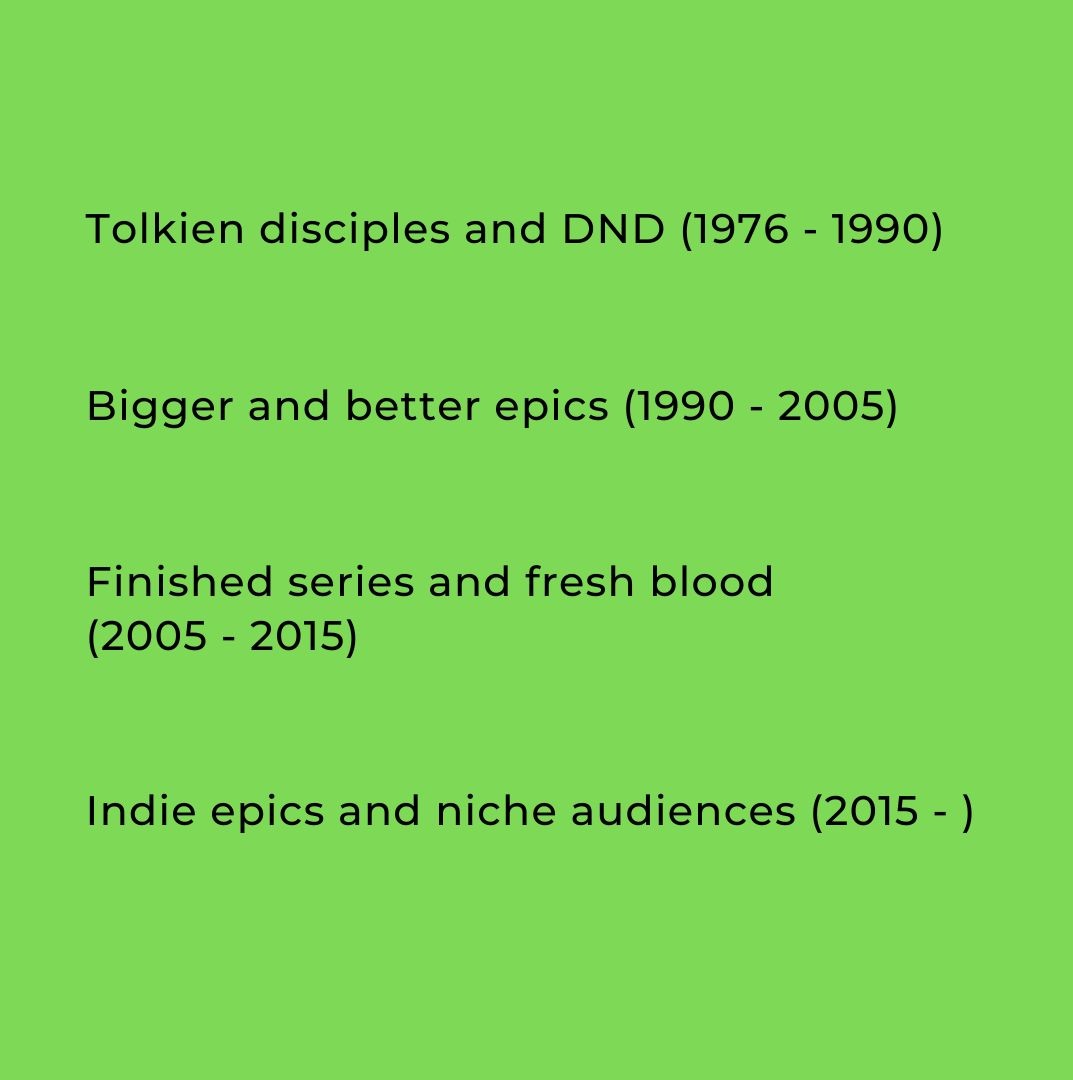
Here are the eras I’ll analyze:
- Tolkien disciples and DND (1976 – 1990)
- Bigger and better epics (1990 – 2005)
- Finished series and fresh blood (2005 – 2015)
- Indie epics and niche audiences (2015 – present)
1. Tolkien disciples and DND (1976 – 1990)
It will surprise no one that the first era following Tolkien had a lot of Tolkien following. Some of this was subtle. Other examples were plain in their worship. There was, as yet, no escaping the shadow Tolkien had cast (and I’m not even trying to analyze the 20 years since The Lord of the Rings was first published).
Fantasy as we know it didn’t yet have its own genre labels or bookshelves. But this era did a lot to set the table.
Early genre trailblazers
Within just a few years, Stephen Donaldson published his first trilogy in The Chronicles of Thomas Covenant. It’s a dark but well-regarded portal fantasy (one of many to come). With an overtly flawed protagonist and an unromantic worldview, Donaldson stood out immediately.
These books made literary space for the lower, grittier elements that wouldn’t become mainstream in fantasy until the early 2000s.
Meanwhile, Patricia McKillip completed her vastly different Riddle Master trilogy. McKillip brought a more poetic sensibility that echoed the elevated style of Tolkien without shame. She nonetheless gave readers an incredibly original setting and plot. Today’s readers likely wouldn’t realize what a Tolkien fan McKillip was when she wrote this trilogy.
Terry Brooks’s Sword of Shannara Trilogy likewise followed Tolkien’s footsteps. Brooks leaned into the quest-like structure of The Lord of the Rings and the adventurous tone of The Hobbit. It’s fair to say that his debt also borrowed plot elements from The Lord of the Rings wholesale. But his trilogy found its own direction quickly, ushering in many followers of his own (and transporting readers into a world that would last 45 books and counting).
Raymond Feist’s Riftwar Cycle and Anne McCaffrey’s Dragonriders of Pern were big hits in this era as well. These and other new authors showed publishers that fantasy had at least as much potential as its more well-established sibling science fiction.
The DND contingent
Meanwhile, there was this growing thing called Dungeons and Dragons (DND).
Without going into all the cultural gravity of DND, it’s clear that DND had a huge impact on epic fantasy. Much of it sprang from Tolkien (like the followers above). Large readerships also came into fantasy solely through licensed DND content.
Dragonlance (Tracy Hickman and Margaret Weis) and The Legend of Drizzt (R. A. Salvatore) were two especially popular series in this era. Readers often recommended these DND-affiliated works right alongside Gene Wolfe’s The Book of the New Sun or Ursula Le Guin’s Earthsea Cycle (though that’s not something I will do). Perhaps because of the hunger for more or perhaps because of how new the genre was, fantasy readers drew fewer lines in the sand and accepted fantasy books almost wherever they could find them.
The long and short is that epic fantasy flourished. It found publishers, found bookstore shelf space, and found readers.
2. Bigger and better epics
If Era 1 was about finding readers, Era 2 was about keeping them for the long (or very long) haul. Books got fatter, and series got longer. We also saw the emergence of several more thoughtful epics (following a general pulpiness of the 80s).
Tad Williams was one of the early greats in this era. Williams gave readers a very Tolkien-like journey in his Memory, Sorrow, and Thorn trilogy. He also offered a setting, style, and thematic journey that was much richer than the bubblegum fantasy works dominating the previous several years. Yet Williams stayed closer to Tolkien in style and tone than writers like Wolfe or Donaldson had, while still offering originality and depth (including a much lower-magic approach to epic fantasy) than many of his immediate predecessors.
Robert Jordan and Terry Goodkind were, if anything, even more defining writers in this era. Both authors set the stage for long, connected series. To date, most epic fantasy had been contained in just a few volumes. Authors typically just wrote trilogies, modeled after the three-book publication format in which they’d encountered Tolkien. Some longer, connected series existed (McCaffrey’s Dragonriders of Pern, for instance), but it was rare to see anything beyond three or four books that continued a single storyline.
Goodkind and Jordan doublehandedly changed this with their long, continuous series hitting shelves at the same time. And readers loved the long, newly large journey Jordan and Goodkind were offering.
L. E. Modesitt and Kate Elliott soon followed (with their The Saga of Recluce and Crown of Stars series respectively). So did Robin Hobb with her amazingly poignant Realm of the Elderlings series. This era also introduced the soon to be phenomena called A Song of Ice and Fire and Malazan, both which followed in the longer path Jordan and Goodkind had made mainstream so quickly.
Gone were the days when the trilogy was the ultimate form for epic fantasy. Five, seven, even fourteen books in a single story was an idea readers liked, thanks to a few daring authors and some bold publishers backing them. And it wasn’t only about length either. There was new depth and breadth to so many series coming out.
3. Finished series and fresh blood
The challenge with big series is that it takes years—even lifetimes—to complete them. A distinct new era arrived before Jordan or Goodkind finished their landmark series. Also, the publishing world was getting tired of waiting.
If you scour the internet, you’ll find many a forum discussion and blog article in this era talking about epic fantasy being out of date. Urban was all the rage. Harry Dresden grew in popularity and Twilight permeated mixed groups of readers. Publishers, in particular, kept saying they wanted something different from old, second-world epics.
The profile of emerging talent and readerships paints a somewhat different picture.
Big changes rolling across the genre
Between 2005 and 2015, several major things happened to cement epic fantasy’s lasting place.
- Endings: Readers did indeed reach the final volumes of Goodkind’s Sword of Truth series and Jordan’s The Wheel of Time. These were both huge milestones, especially for doorstopper epic series.
- Beginnings: The genre saw a massive influx of new talent. Patrick Rothfuss, Joe Abercrombie, Scott Lynch, Daniel Abraham, Elizabeth Bear, Brandon Sanderson and Naomi Novik all hit the scene within just two years of each other. N. K. Jemisin, Peter V. Brett and others debuted only a few years after that. The masters of the previous era (many who were completing their series now) were replaced at an incredible clip.
- Pausings: We also had a few high profile delays in epic fantasy publishing during this time. We just didn’t know how big the delays would be for writers ranging from J. V. Jones to Scott Lynch to George R. R. Martin. But some of the most popular series out there got delayed. And delayed again.
While new talent swept in to take the spotlight from more recent writers, authors from earlier eras also made new splashes. Terry Brooks released his Genesis of Shannara trilogy, one of his strongest out of all his connected works and an early marker of the direction his series would go to completion. Tad Williams came back strong to epic fantasy with his Shadowmarch series. Sean Russell completed his Swan’s War trilogy, which remains his most epic fantasy work to date (and a personal favorite of mine).
Grimdark also saw a rapid rise during this era. A few authors had dipped into this subgenre already (Paul Kearney, for instance). But Richard K. Morgan and Mark Lawrence cemented the subgenre, largely following Abercrombie’s popularizing influence.
More new works hit the shelves
Oh, and now that a few big series were done, we started to get new ones. There were modest-sized epics like Brent Weeks’s Lightbringer series (perhaps a million words in all). And then, even before finishing Jordan’s The Wheel of Time, Sanderson began publishing his own massive epic, The Stormlight Archive. Furthermore, Tad Williams came back with more Osten Ard books, and Robin Hobb kept extending the breadth of her Realm of the Elderlings.
This period brought huge momentum for established writers while introducing a host of new voices. No matter what publishers claimed early on, it was a momentous time to be reading epic fantasy.
4. Indie epics and niche audiences (2015 – present)
With several decades of fantasy works available now, readers started getting pickier. Gone were the days when I’d jump from Icewind Dale (R. A. Salvatore) to Gene Wolfe’s Shadow and Claw (and yes, I really did read these back to back). With so many choices, readers could find what they really wanted.
There was this thing called social media, too. And smartphones making book recommendations available all day, every day. The big book recommendation forums folded into subreddits, and bloggers started becoming influencers. As a result, micro communities and niche audiences became all the norm. It was just a lot easier to find books that truly fit the vibe you wanted.
Enter indie fantasy.
Indie epic fantasy at a glance
A few important indie figures predated this era. Michael J. Sullivan, for instance, started selling well a few years earlier. But the advent of new tools to find books made it possible for hundreds of indie fantasy authors to carve out their own places in the epic fantasy landscape. Several quickly aligned with traditional publishers (David Dalglish, Evan Winter, Anthony Ryan, and Sullivan mentioned above), though they often kept indie works moving as well. Others stuck purely to indie avenues, often finding commercial success through small but loyal audiences and faster times to publish.
Indie publishing of course changed every aspect of book publishing. But for epic fantasy—which had grown into long series, protracted publishing timeframes, and even delayed completion—indie publishing was almost as game-changing as the mega-series model Goodkind and Jordan had introduced in the 90s. If you want more quest-like fantasy reminiscent of early Salvatore or Brooks, you can find it. If you want something punchier or darker, you can find that too. Short, long, high or low magic, indie fantasy has flooded readers’ to-be-read lists with relevant titles, often super-focused on specific reader interests.
This has somewhat diluted the author-as-brand model of loyalty that dominated book publishing in all previous eras. But it has also made epic fantasy (all fantasy) more generally varied and inclusive.
What’s next for epic fantasy?
Few authors remain actively writing from the first era I’ve analyzed for this article. Brooks has retired. Salvatore has moved on to writing books about Breezy Do’Urden (props for that, Drizzt probably has enough books by now). Writers from the next era have mostly retired as well.
It’s clear that a lot of readers are still watching Jemisin, Abercrombie, Sanderson and others from era 3. But it has been the better part of two decades since we’ve had a single debut with as much gravity as some of the 90s and 00s others managed. There’s too much publishing noise, too much volume for it to happen the same way (yet).
Oh, and there’s AI. So here are a few things we can expect to see happen in the next era of epic fantasy.
- Continual glut of content, including numerous AI-written novels that come and go rapidly
- Steeper segmentation of readership as micro-communities hover around their influencer voices and subgenres of choice
- Completion of the largest works outstanding from the last era (or two eras, hopefully)
- A general decline in publisher interest in epic fantasy until a few more major new authors hit the scene (little wonder that romantasy is the dominant player right now)
- Plenty of great authors still writing great epic fantasy, regardless of publisher preference
There hasn’t truly been a bad time to be an epic fantasy reader in 50 years.
I don’t think there ever will be.
For more nerdy content like this, sign up for the monthly newsletter. It’s free to sign up, and you can unsubscribe any time.
About the Author

Stephen Taylor is the author of The Witherclaw Trilogy as well as short fiction appearing in The Future Fire, MYTHIC Magazine, The Centropic Oracle, and other publications. His short story “Only an Ocean” won a Silver Honorable Mention in the L. Ron Hubbard Writers of the Future Contest. When he’s not writing, he’s often playing his violin or wandering in the woods.

Leave a Reply